

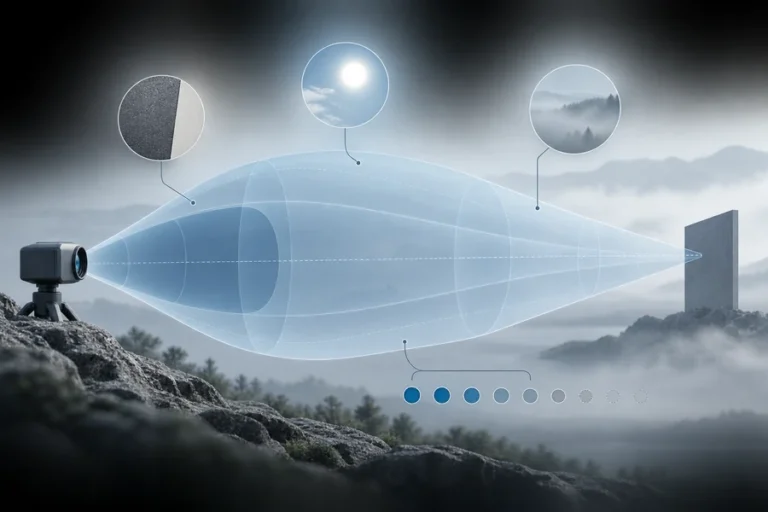

A clear-air maximum range does not tell you what happens when visibility drops. In fog, rain, or haze, a rangefinder may lock at a shorter distance, return an unexpectedly close value, alternate between valid and invalid readings, or produce no result at all.
Those symptoms come from different mechanisms, so “weak signal” is not a sufficient diagnosis.
A laser rangefinder in fog can still produce valid distances in light conditions, but usable range and detection probability normally decrease as particles attenuate the two-way target signal and create competing echoes. Performance must be stated with visibility, precipitation, target, geometry, optical-window condition, processing settings, and a valid-detection criterion.
Why a Laser Rangefinder in Fog Loses Usable Range
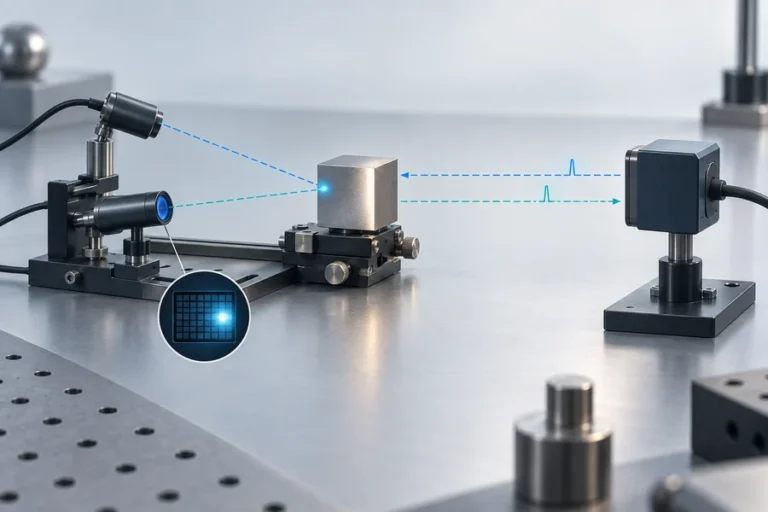
A pulsed time-of-flight rangefinder sends optical energy toward a target and times the return. The clean-air sequence is covered in our guide to how a laser rangefinder works. Fog adds two problems to that signal path.
First, droplets scatter and absorb part of the transmitted pulse before it reaches the target. The intended echo then passes through the same obscuring volume on the return trip. That two-way path loss lowers the target signal relative to receiver noise and background light.
Second, droplets inside the measurement path can send energy back before the pulse reaches the target. A receiver may interpret this volume return as close clutter or an early object. Controlled fog-chamber work has shown both effects: close points accumulate around the sensor while the maximum viewing distance falls as target echoes disappear into noise.
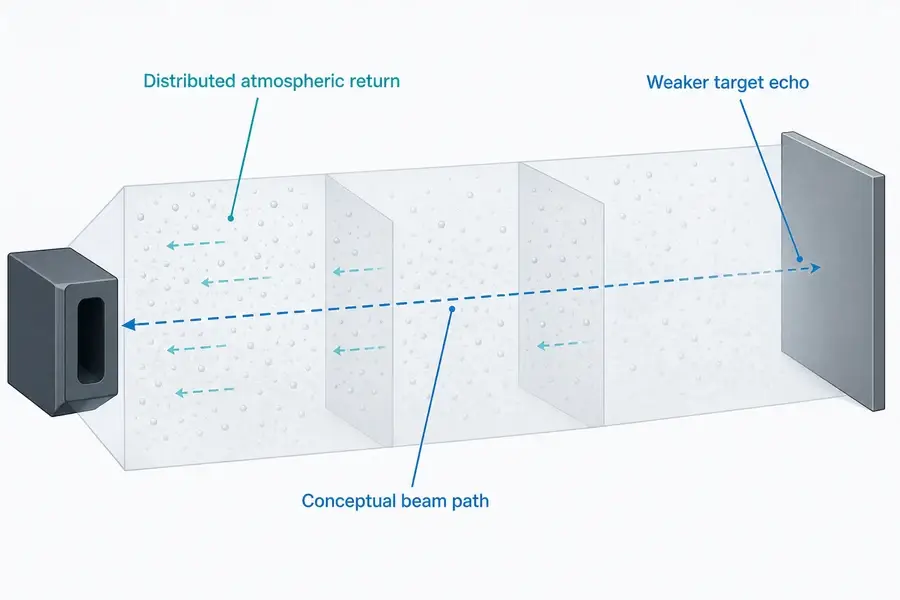
The decline is not always gradual. A system may appear stable until the target echo crosses its threshold, then switch to intermittent or absent readings.
Fog, Rain, and Haze Create Different Failure Patterns
All three conditions reduce visibility, but they do not create the same optical or mechanical problem.
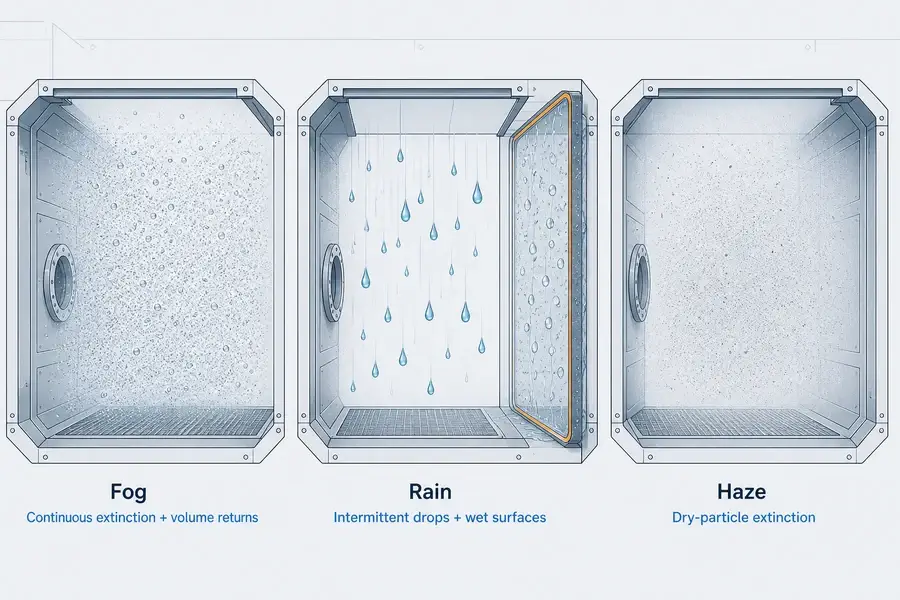
Fog: Continuous Extinction and Volume Returns
The World Meteorological Organization defines fog as suspended small water droplets that reduce surface visibility. Droplet size and spatial uniformity vary, so events with the same reported visibility can affect a sensor differently.
Fog often fills the complete optical path. That makes continuous attenuation and volume backscatter the main concerns. It can also wet the target and protective window, adding surface effects to the atmospheric loss.
Rain: Intermittent Drops and Wet Surfaces
Raindrops are larger and more discrete than fog droplets. A drop crossing the beam can create a false return, block part of the pulse, or mix with the target echo. Controlled experiments found that rain or mist loading reduced target-acquisition probability more than the error of valid readings.
Rain introduces a second problem that fog discussions often miss: water on the optical window. A sealed enclosure may prevent water ingress while droplets, a water film, or contamination on the exterior surface still scatter the outgoing pulse and receiver field. Wet targets and puddles can also change surface directionality and create multipath or ghost returns.
Haze: Dry-Particle Extinction
WMO defines haze as extremely small dry particles suspended in the air. Haze can reduce optical transmission and raise scattered background, but its particle composition and distribution differ from water-droplet fog.
Record the condition and a measured visibility or extinction indicator when possible.
The Readout Symptom Does Not Identify the Cause by Itself
Use the output pattern as a clue, then check the path and settings.
| Symptom | Plausible mechanism | Check next |
|---|---|---|
| Unexpectedly short range | Near fog/droplet echo or contaminated window | Inspect raw/multiple echoes and the window surface |
| No return | Target echo below threshold or optical path blocked | Check visibility, target return, aperture, and threshold |
| Intermittent valid/invalid readings | Discrete drops, changing fog density, or partial footprint | Record repeated trials and weather condition over time |
| Stable but shorter usable range | Distributed atmospheric extinction | Compare clear-air and obscured detection probability |
| Biased or ghost distance | Mixed returns or multipath from wet surfaces | Change geometry and inspect first/strongest/last echo behavior |
“Accuracy ±x” usually describes successful readings, not how often the sensor returns a valid, false, or absent distance in fog.
Wavelength Alone Does Not Guarantee Better Fog Performance
Choosing a wavelength from one transmission statement ignores droplet distribution, visibility, transmitter/receiver design, divergence, filters, target reflectance, and safety constraints.
Meteorological optical range (MOR) is easy to misuse. WMO defines MOR with visible-light photometry: it is the path length that reduces specified luminous flux to 5% of its original value. MOR can label a fog test, but it is not direct transmission data at a 905 nm or 1535 nm ranging wavelength.
A controlled SAE study correlated a visibility sensor with one 1.55 μm LiDAR in a chamber. That supports measured-condition testing, not universal wavelength superiority. For source-level variables around wavelength, pulse format, and receiver matching, see our ranging laser source overview.
What Fog and Rain Filters Trade Away
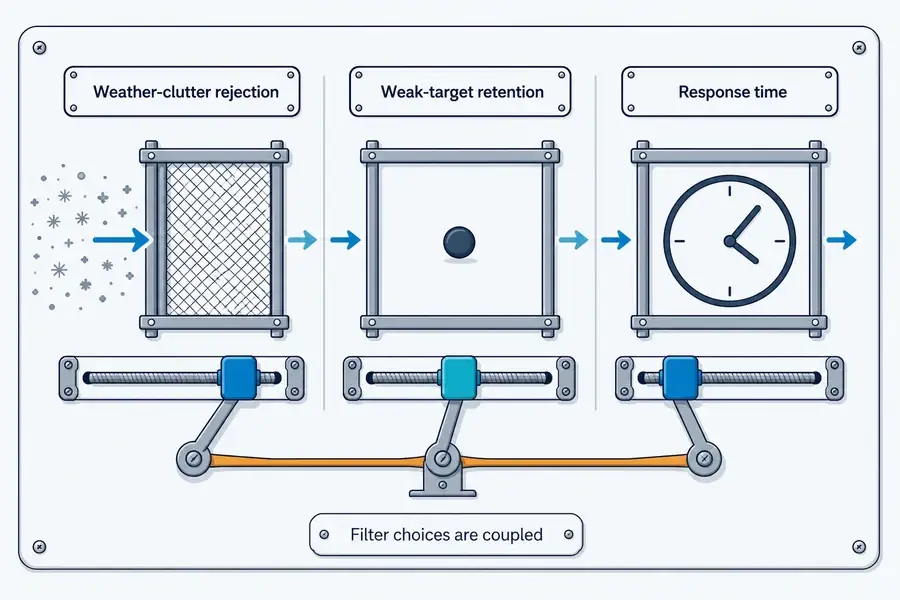
“Fog mode” is not one standard algorithm. Depending on the device, it may change echo selection, range gates, signal thresholds, persistence rules, averaging, or integration time.
Echo Selection and Range Gating
Selecting a later echo can reject a close droplet return when the desired object is farther away. It can also select a background behind a small target if part of the beam footprint misses that target. First, strongest, and last echo are choices tied to scene geometry—not universal good, better, and best settings.
Thresholds and Temporal Filtering
Raising a signal threshold can suppress weak fog clutter. It can also suppress the intended return from a dark, thin, small, or distant target. Increasing measurement time or averaging may improve weak-return stability, but the output updates more slowly and moving objects become harder to track.
Manufacturer manuals warn that rain filters can reduce moving-object sensitivity, fog filters can miss low-reflectance targets, and last-echo selection can miss objects smaller than the beam. Validate the selected mode against the weakest target and fastest motion the application must handle.
IP Rating Is Not an Adverse-Weather Range Specification
An ingress-protection rating addresses enclosure protection under defined tests. It does not show how far a rangefinder will measure through fog or rain, how it handles competing echoes, or what happens when droplets remain on the optical window.
Outdoor integration requires separate optical controls: hood, drainage, mounting angle, window heater or air purge, contamination detection, and cleaning access. Test the installed window because coating, angle, and contamination can change the return path.
Qualification belongs to the finished optical and mechanical configuration, not a bare-module enclosure claim.
How to Test a Laser Rangefinder in Fog or Rain
Start with a clear-air baseline, change one weather variable at a time, and record the condition.
- Characterize the target reflectance at the operating wavelength, size, incidence angle, and footprint coverage.
- Define fog with MOR/visibility and generation method; define rain with rate, droplet method, direction, and duration.
- Separate weather in the path from a dry, wet, and contaminated optical window test.
- Lock distance, alignment, sensor settings, supply, update rate, and target motion.
- Collect enough repeated trials to report valid detections, false returns, absent returns, and error on valid readings.
- Repeat across the weakest target, longest range, fastest motion, and window condition the application requires.
| Test field | What to record |
|---|---|
| Weather severity | MOR/visibility or rain rate and generation method |
| Target | Reflectance, size, angle, distance, and motion |
| Optical path | Clear, fog, rain, haze, and spatial uniformity |
| Window state | Dry, droplets, water film, contamination, and mitigation active |
| Sensor state | Wavelength, mode, echo selection, threshold/filter, and update rate |
| Outcome | Valid-detection probability, error window, false-return rate, and no-return rate |
DIN SAE SPEC 91571:2026-04 is a current test-method framework for LiDAR performance in adverse conditions. Use the complete applicable document rather than inferring methods from its public summary.
For range specifications beyond weather, use our maximum-range condition guide. The rangefinder datasheet guide helps organize target, environment, probability, and optical-condition fields for supplier comparison.
What to Send Lumexis for Module Review
Share the clear-air and adverse-condition distances, target reflectance and size, MOR or rain condition, window design, field of view, update rate, envelope, interface, and acceptable false/no-return behavior.
Our applications engineers can help evaluate a standard laser rangefinder module or a custom/private-label requirement through selection, integration, validation, and troubleshooting. See the laser-ranging solution and engineering services pages for project context. Any adverse-weather claim still needs final-configuration test evidence.
Frequently Asked Questions
Will a Laser Rangefinder Work in Light Fog?
It may, but expect less return margin and shorter usable range than in clear air. The outcome depends on visibility, droplet distribution, distance, target reflectance, receiver settings, and the optical window. Verify detection probability and false-return rate instead of checking whether one valid reading is possible.
Why Does Fog Sometimes Produce a Very Short Distance Reading?
Fog droplets close to the sensor can return part of the pulse before it reaches the intended target. If that atmospheric echo crosses the detection threshold or wins the selected echo rule, the system may report the fog volume as a nearby object. Window condensation can produce a similar symptom.
Does 1535 nm Always Work Better Than 905 nm in Fog?
No. Fog performance depends on particle distribution and the entire transmitter-receiver design, not wavelength alone. MOR is measured with visible-light conventions, so it cannot directly rank two NIR/SWIR systems. Compare condition-matched measurements that include target, aperture, power, sensitivity, processing, and safety constraints.
What Does a Fog Filter Do?
It may raise a near-range threshold, reject small or unstable echoes, select a later return, or average measurements. These choices can suppress fog clutter but may also lose weak, small, thin, or moving targets. The exact behavior is device-specific and should be validated with the intended target set.
How Should Adverse-Weather Range Be Specified?
State the weather metric, target reflectance/size/angle, distance, optical-window state, sensor mode, trial count, valid-return definition, probability of detection, error on valid readings, and false/no-return rates. A single “fog range” without those conditions is not portable across systems or sites.
Share your target, distance, MOR or rain envelope, optical-window design, update rate, interface, and pass/fail criteria through the Lumexis contact page. We can identify a standard-module starting point or define what a custom validation plan needs to prove.
References
- Bijelic, M. et al. A Benchmark for Lidar Sensors in Fog: Is Detection Breaking Down?
- Ryde, J. and Hillier, N. Performance of Laser and Radar Ranging Devices in Adverse Environmental Conditions
- World Meteorological Organization. Meteorological Optical Range (MOR) definition
- Zhan, L. and Northrop, W. Impact of Fog Particles on 1.55 μm Automotive LiDAR Sensor Performance