



Two pump modules, same 976 nm center wavelength on the label, same rated power, same fiber core diameter. One holds output flat across the operating range. The other loses efficiency every time the coolant loop warms up.
Nothing on either datasheet’s front page explains the difference. It is on page three, in the linewidth spec and the wavelength-versus-temperature curve, and it is the single most consequential number in fiber laser pump selection.
This guide covers the decisions that actually determine whether a pump choice works: which wavelength, which diode architecture, how brightness constrains your options, and what stabilization buys you.
Table of Contents
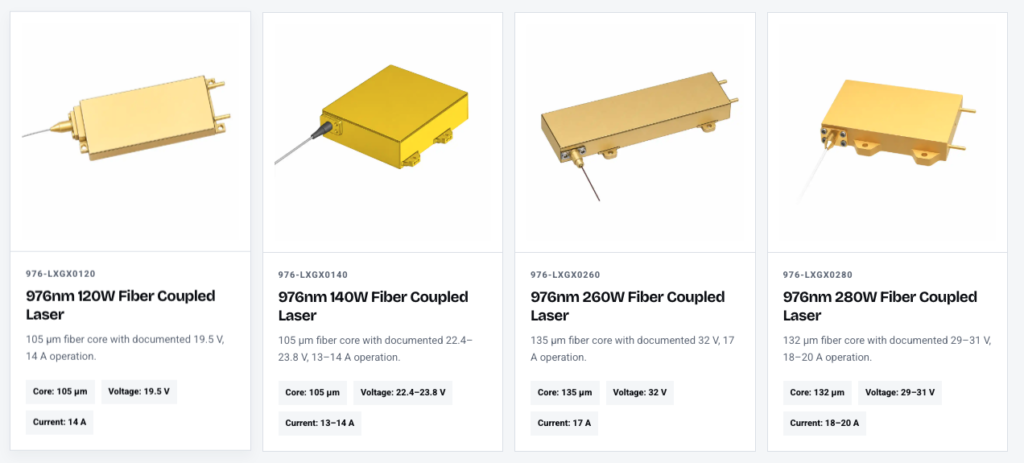
A fiber laser pump diode is a high-power semiconductor laser, usually fiber-coupled, that excites the rare-earth dopant in an active fiber. Ytterbium and erbium-ytterbium systems are pumped near 915 nm or 976 nm. Modules range from single emitters at around 15 W to multi-bar stacks delivering kilowatts.
The first decision: 915 nm or 976 nm
For ytterbium and erbium-ytterbium fiber, this choice cascades into everything else. It is worth making deliberately rather than defaulting to whatever the last design used.
976 nm sits on ytterbium’s strong, narrow absorption peak. Because absorption is high, you need less active fiber, and because the pump photon is closer in energy to the ~1064–1080 nm output, the quantum defect is smaller and less heat is generated per absorbed photon. Optical-to-optical efficiency is the best available.
The catch is that peak’s width. Ytterbium’s absorption feature at 976 nm is narrow — at least an order of magnitude narrower than erbium’s at the same wavelength. A plain Fabry-Pérot diode emits with a linewidth around 6 nm and drifts roughly 0.3 nm per °C of junction temperature. Put those together and an unstabilized 976 nm pump walks off the absorption peak as it warms. Absorbed power falls, unabsorbed pump propagates down the fiber where it does not belong, and output drops in a way that looks like a fiber problem.
So a 976 nm design essentially requires wavelength stabilization, tight thermal control, or both.
915 nm sits on a broader, weaker absorption feature. The cross-section is smaller and wider, and that changes the engineering in several directions at once. Because absorption is weaker, you need a longer active fiber and you accept lower optical-to-optical efficiency. Because the feature is broad, diode drift over temperature barely matters — the pump stays usefully absorbed across a wide wavelength range, which means stabilization and precision cooling become optional.
There is a second, less obvious benefit. Weaker absorption spreads the pump deposition over a longer fiber length, which lowers local thermal load and raises the transverse mode instability threshold. That matters enormously at high power. A 2024 kilowatt-class 915 nm-pumped oscillator reported 75.4% optical-to-optical efficiency — below what 976 nm can reach, but achieved with markedly relaxed thermal and stabilization requirements.
| 915 nm | 976 nm | |
|---|---|---|
| Absorption | Broad, weaker | Narrow, strong |
| Efficiency | Lower | Highest available |
| Quantum defect / heat | Higher per photon | Lower per photon |
| Fiber length needed | Longer | Shorter |
| Stabilization | Usually unnecessary | Effectively required |
| Thermal control | Relaxed | Tight |
| Mode instability threshold | Higher (heat spread out) | Lower (heat concentrated) |
| Best for | Rugged, high-power, field-deployed | Efficiency- and size-critical |
The short version: 976 nm buys efficiency and compactness at the cost of control complexity. 915 nm buys ruggedness and thermal headroom at the cost of efficiency. If your system lives in a temperature-controlled cabinet, 976 nm is usually right. If it lives on a vehicle, a vessel, or an unconditioned factory floor, 915 nm deserves serious consideration.
Hybrid schemes exist — pumping partly at each wavelength, or tandem pumping at 1018 nm to cut the quantum defect further — but those are optimizations to reach for after the base architecture is settled.
Single-mode or multimode
The second fork is about beam quality versus power, and it is largely decided by what you are pumping.
Single-mode pumps couple into a single-mode fiber with a core around 6–9 µm. Beam quality is excellent and the output can be launched directly into a signal core. Power is limited — typically well under 1 W per device — and cost per watt is high. These are for core-pumped amplifiers, seed stages, low-noise applications, and erbium telecom-band amplifiers.
Multimode pumps couple into multimode fiber, commonly 105/125 µm, and scale from hundreds of milliwatts to several hundred watts per module. Beam quality is poor by comparison, which is precisely why cladding pumping exists: launch the pump into a large multimode inner cladding rather than the tiny doped core, let it cross the core repeatedly over meters of fiber, and you get single-mode output from a multimode pump. Nearly all high-power fiber lasers work this way.
If you are building a cladding-pumped system — and for anything above a few watts you are — multimode is the answer, and the real question becomes which multimode architecture.
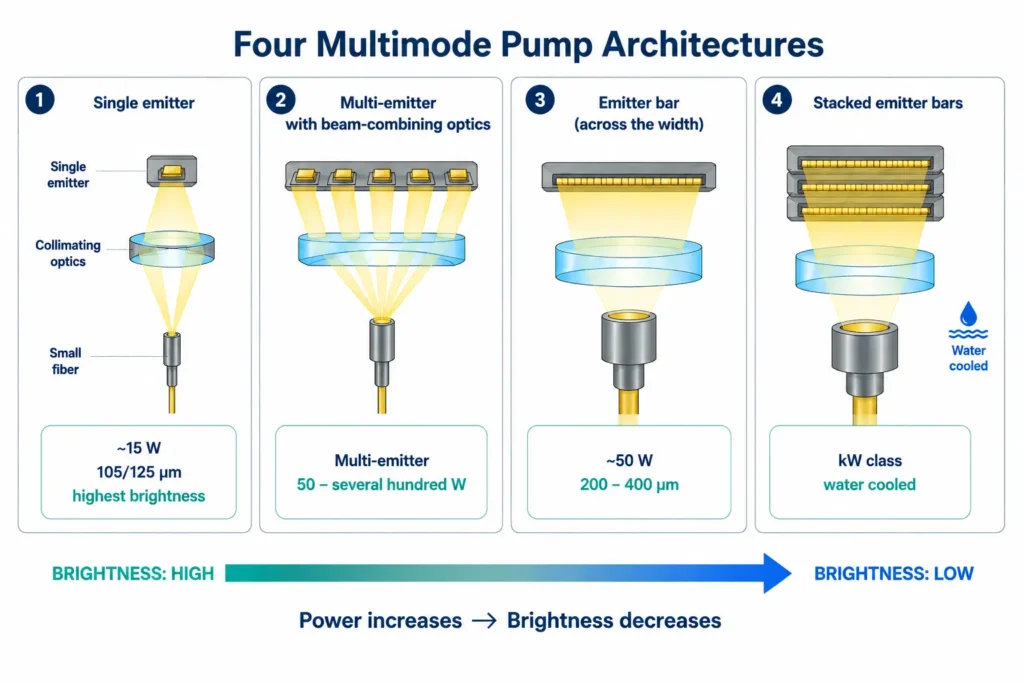
Four multimode architectures
Pump modules are built four ways, and the differences show up in power, brightness, cost, and how they fail.
| Architecture | Typical power | Delivery fiber | Character |
|---|---|---|---|
| Single emitter | ~10–25 W | 105/125 µm | Highest brightness per watt; one emitter, one failure point |
| Multi-emitter module | ~50–several hundred W | 105–200 µm | Several discrete emitters beam-combined into one fiber; graceful degradation |
| Single bar | ~50 W | 200–400 µm | Many emitters on one monolithic bar; lower brightness, low cost per watt |
| Multi-bar / stack | Hundreds of W to kW | 400 µm and larger | Bars stacked; highest power, lowest brightness, water cooling typical |
A few things worth understanding about this table.
Single emitters give the best brightness. One emitter’s output can be collimated and focused into a small fiber with high efficiency, so you get more watts per unit of étendue. Multi-emitter modules preserve much of that by combining several single emitters spatially and by polarization, which is why they dominate mid-power fiber laser pumping.
Bars trade brightness for cost. A bar packs many emitters side by side on one chip. Total power is high and cost per watt is low, but the emitters are spread across a wide slow axis, so coupling into a small fiber is inefficient. You end up needing a larger delivery fiber, which constrains the cladding diameter you can pump into.
Failure behavior differs. In a multi-emitter module, one dead emitter costs you a fraction of the power and the system usually keeps running. On a monolithic bar, a single emitter failure can propagate. This is a reliability argument that rarely appears on datasheets and matters a great deal for unattended or field-deployed systems.
Brightness, NA, and why the fiber number matters
Two pump modules can both say “50 W” and be entirely different products. What separates them is brightness.
Brightness is power divided by the product of emitting area and solid angle. In fiber-coupled terms, that translates to power divided by the product of core diameter and numerical aperture. A 50 W module in a 105 µm / 0.22 NA fiber is a far more useful device than 50 W in a 400 µm / 0.22 NA fiber, even though the label power is identical.
Two consequences follow directly, and both bite late in a design if they are not budgeted early.
Brightness cannot be improved downstream. Optics can reshape a beam, but the product of size and divergence — étendue, expressed for beams as beam parameter product — cannot be reduced by passive optics. If your pump arrives with too much étendue for your fiber’s inner cladding, no lens fixes it. You lose the excess as heat at the launch.
Cladding diameter is a system-level constraint. A larger inner cladding accepts lower-brightness pump light more easily, but it also lowers cladding absorption per unit length, so you need more fiber. Smaller cladding absorbs faster and gives better mode control, but demands brighter pumps. Pump brightness and fiber design are one decision, not two.
The practical instruction: never accept a pump power figure without the core diameter and NA attached. Power alone is not a specification.
Wavelength stabilization: what it actually costs and buys
An unstabilized broad-area Fabry-Pérot diode has a linewidth of several nanometers and its center wavelength moves with both junction temperature (roughly 0.3 nm per °C) and drive current. For a 915 nm design that is fine. For 976 nm into ytterbium it is usually not.
Three approaches exist.
Fiber Bragg grating (FBG) stabilization writes a grating into the pigtail, reflecting a narrow band back into the diode and forcing it to lase there. This is the dominant method for fiber-coupled pump modules. It typically narrows emission below 0.5 nm and largely decouples wavelength from temperature and current.
Volume Bragg grating (VBG) stabilization places a bulk grating as the output coupler, usually paired with a reduced front-facet reflectivity so the grating wins the competition for gain. Common in free-space and module-level designs.
No stabilization, paired with either tight temperature control or a deliberately tolerant absorption band. This is the 915 nm route, and done knowingly it produces the simplest system.
Two details worth knowing before specifying a locked pump.
The grating’s design wavelength must sit close to the chip’s natural peak emission — within roughly ±5 nm — or the diode will not lock reliably across its operating range. This is a manufacturing-side constraint, but it determines how much temperature margin a locked module really has.
Locking is not instantaneous. FBG-based stabilization takes a finite time to establish after turn-on, because light must make a round trip to the grating and back. For continuous-wave pumping this is irrelevant. For pulsed or rapidly modulated pumping, the first portion of each pulse can emit unlocked and spectrally broad, which affects absorption and can surprise you in a QCW design.
Getting the pump into the fiber
Between the pump module and the active fiber sits a component that quietly determines a lot of system behavior: the pump combiner.
A pump-signal combiner takes several multimode pump fibers plus, usually, one signal fiber through the center — the (6+1)×1 and (18+1)×1 configurations are common — and tapers them into a single double-clad output fiber. Pump light lands in the inner cladding; the signal passes through the core untouched.
Three things about combiners are worth knowing at specification time.
Brightness conservation applies here too. The taper cannot concentrate pump light beyond what étendue permits. Feeding a combiner with pumps that are too low in brightness for the output cladding wastes power as heat right at the taper — a common cause of combiners running hot.
Pump count sets your redundancy granularity. A (6+1)×1 combiner with six pump modules degrades gracefully; losing one costs roughly a sixth of the pump power. Two very large modules feeding a 2+1 gives you a far more brittle system.
Backward-propagating light is a real hazard. Unabsorbed pump and back-reflected signal travel toward the pumps. Cladding light strippers and proper isolation are not optional above modest power levels, and pump diodes damaged by back-reflection are frequently misdiagnosed as random failures.
Packaging, drive, and thermal interface
The package is where the pump meets your mechanical and electrical design.
14-pin butterfly packages are the standard for lower-power and single-mode devices, typically integrating a TEC and a thermistor so junction temperature can be actively held. They cost board space and power, and the TEC becomes a component in your reliability budget.
Fiber-coupled multimode modules at tens to hundreds of watts are usually conduction-cooled to a baseplate, with a specified maximum case temperature and thermal resistance. Above a few hundred watts, water cooling is typical.
Electrically, expect a single emitter to want roughly 1.5 V at 10–20 A. Emitters wired in series raise voltage and keep current the same; bars run parallel arrays and pull 45–60 A at similar voltages. Multi-bar stacks in series climb in voltage accordingly. The reason to care is that your driver’s compliance voltage, current stability, and transient protection all follow from this, and pump diodes are unforgiving of current overshoot at turn-on.
One thermal point that gets underestimated: the specified case temperature is not a suggestion. Junction temperature drives wavelength, and wavelength drives absorbed power. In a 976 nm system, a thermal interface that degrades over time — dried compound, a loosened screw, a fouled cold plate — presents as slow output decline that looks like diode aging. It often is not.
What to ask a pump supplier
The generic advice about reading datasheets skeptically applies. These are the pump-specific questions.
Is the center wavelength specified with a tolerance and a reference case temperature? A bare “976 nm” is not usable. You need the number, the tolerance, and the temperature it was measured at.
What is the linewidth, and is the device locked? For 976 nm into ytterbium, the answer determines whether the design works.
What is the delivery fiber core and NA, and what is the power measured at the connector? Not chip power, not pre-coupling power. What comes out of the fiber you will actually connect.
Was every unit burn-in screened, or a sample? Diode lasers fail early or run for years. Burn-in is how you separate those populations before shipment, and screening every unit costs the supplier real yield — which is why some do not.
Is the package hermetic? Facet degradation from moisture accumulates over years. Two modules can look identical on paper and diverge sharply at year three.
Can you see data across the full operating window? Wavelength, power, and threshold at the temperature extremes, not just at 25 °C.
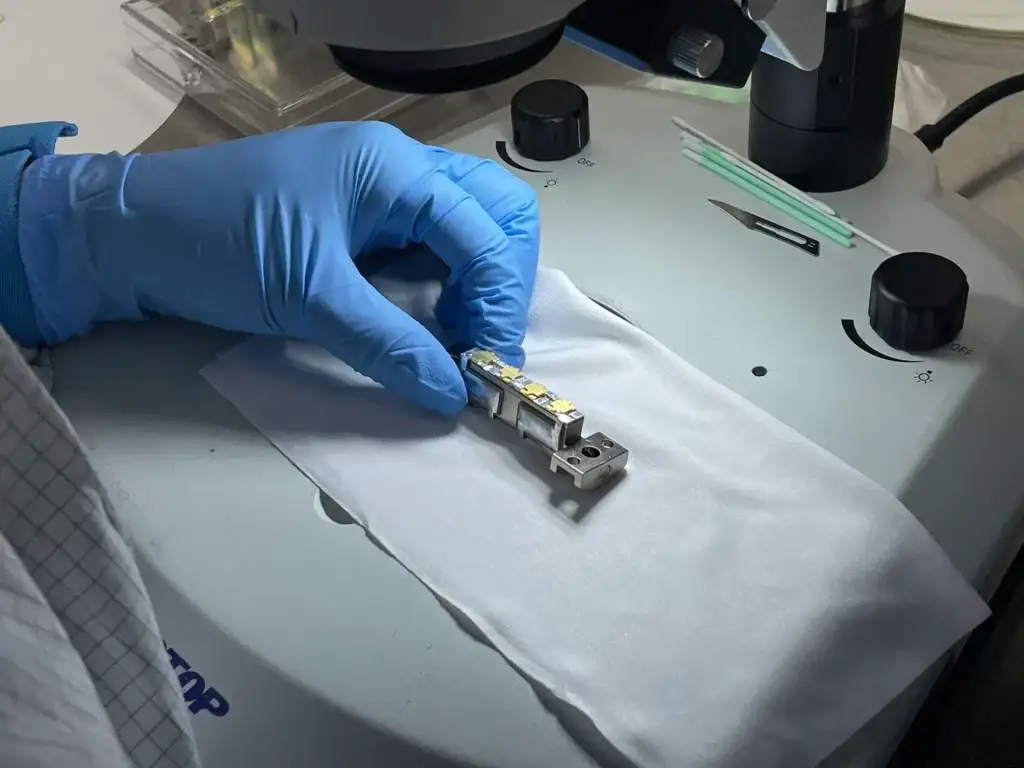
Our own flow for fiber-coupled diode pump sources runs incoming inspection, chip test, die bonding and chip-on-submount assembly, automated fiber coupling and alignment, hermetic sealing by parallel seam welding, then burn-in and high/low temperature cycling before final test. The reason to be vertically integrated is not marketing — it is that when a unit behaves oddly, the trace back to a bonding step or a coupling alignment actually exists. You can review the equipment and test capability behind that, or browse available laser source modules if you are scoping a specific wavelength and power.
Common mistakes
Comparing pumps on watts alone. Without core diameter and NA, the power figure tells you almost nothing about whether the module fits your fiber.
Choosing 976 nm and then discovering the thermal budget. The efficiency advantage is real, but it comes bundled with stabilization and cooling requirements. Decide with the full cost in view.
Assuming brightness can be recovered. It cannot. Étendue only grows through passive optics. Budget it at the architecture stage.
Ignoring back-reflection protection. Cladding light strippers and isolation are load-bearing, not accessories.
Calibrating and qualifying at ambient only. Wavelength and threshold both move with temperature. A 25 °C characterization tells you very little about a −20 °C cold start.
Treating the combiner as passive plumbing. Its brightness acceptance, pump count, and thermal handling shape system reliability as much as the diodes do.
Frequently asked questions
Should I use 915 nm or 976 nm to pump a ytterbium fiber laser?
976 nm sits on a strong narrow absorption peak — best efficiency and shortest fiber, but it needs wavelength stabilization and tight thermal control. 915 nm sits on a broad weak feature — lower efficiency and longer fiber, but tolerant of drift and gentler thermally. Controlled environments favor 976; rugged deployments favor 915.
What is a fiber Bragg grating stabilized pump?
A pump diode with a grating written into its delivery fiber that reflects a narrow band back into the diode, forcing it to lase at that wavelength. It typically narrows emission below 0.5 nm and holds the wavelength largely independent of temperature and drive current — essential for 976 nm ytterbium pumping.
What is the difference between a single emitter and a laser bar?
A single emitter is one emitting stripe, typically 10–25 W, with high brightness and easy coupling into a 105 µm fiber. A bar packs many emitters across one chip for around 50 W at lower cost per watt, but the wide emitting area lowers brightness and requires a larger delivery fiber.
Why does pump brightness matter if I only need total power?
Because brightness determines whether that power can be launched into your fiber’s inner cladding at all. Passive optics cannot reduce étendue, so pump light that is too divergent for the cladding is lost as heat at the launch, regardless of how many watts you started with.
What is cladding pumping?
Launching pump light into a large multimode inner cladding rather than the small doped core. The pump crosses the core repeatedly along meters of fiber and is gradually absorbed, which lets low-brightness multimode diodes produce a single-mode output. It is the basis of essentially all high-power fiber lasers.
Do pump diodes need a TEC?
It depends on wavelength. A stabilized or 915 nm pump often runs on passive conduction cooling with a specified case temperature. An unstabilized 976 nm pump into ytterbium generally needs active temperature control to stay on the absorption peak.
Specifying the pump alongside the fiber
Pump wavelength, pump brightness, cladding diameter, and fiber length are one coupled decision. Settling them independently is how programs end up with a combiner that runs hot and an efficiency figure nobody can explain.
Send us your gain fiber, output requirement, and thermal envelope, and our engineers will work through the pump options with you — including whether stabilization earns its cost on your platform, and what the wavelength-versus-temperature data needs to show for your absorption budget to close.