


Dos módulos de bomba, misma longitud de onda central de 976 nm en la etiqueta, misma potencia nominal, mismo diámetro de núcleo de fibra. Uno mantiene la salida plana en todo el rango de operación. El otro pierde eficiencia cada vez que el circuito de refrigeración se calienta.
Nada en la primera página de ninguna hoja de datos explica la diferencia. Está en la página tres, en la especificación de ancho de línea y en la curva de longitud de onda versus temperatura, y es el número más decisivo en la selección de bombas para láser de fibra.
Esta guía cubre las decisiones que realmente determinan si una elección de bomba funciona: qué longitud de onda, qué arquitectura de diodo, cómo el brillo limita tus opciones y qué te aporta la estabilización.
Tabla de Contenidos
Un diodo de bomba para láser de fibra es un láser semiconductor de alta potencia, generalmente acoplado a fibra, que excita el dopante de tierras raras en una fibra activa. Los sistemas de iterbio y erbio-iterbio se bombean cerca de 915 nm o 976 nm. Los módulos van desde emisores individuales de alrededor de 15 W hasta apilamientos de barras que entregan kilovatios.
La primera decisión: 915 nm o 976 nm
Para fibra de iterbio y erbio-iterbio, esta elección se extiende a todo lo demás. Vale la pena hacerla deliberadamente en lugar de recurrir por defecto a lo que usó el último diseño.
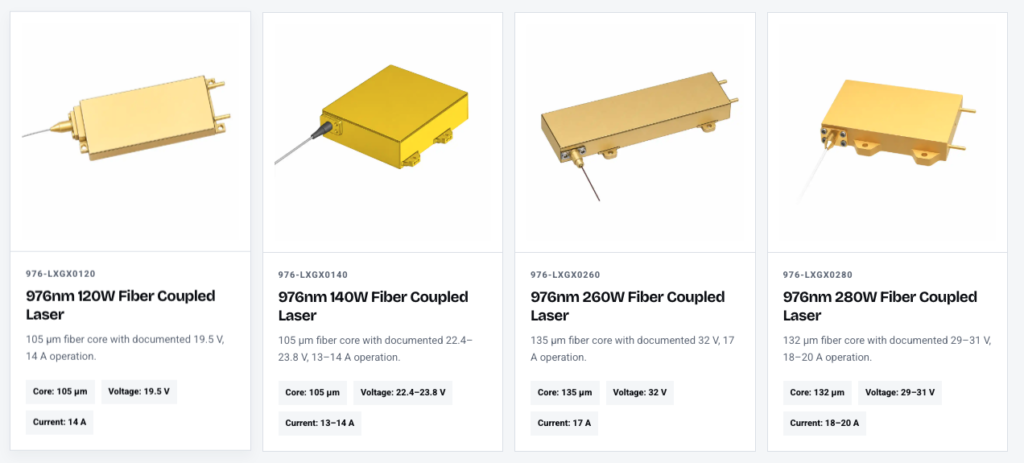
976 nm Se sitúa en el pico de absorción fuerte y estrecho del iterbio. Debido a que la absorción es alta, necesitas menos fibra activa, y como el fotón de bomba está más cerca en energía de la salida de ~1064–1080 nm, el defecto cuántico es menor y se genera menos calor por fotón absorbido. La eficiencia óptica a óptica es la mejor disponible.
El inconveniente es el ancho de ese pico. La característica de absorción del iterbio a 976 nm es estrecha, al menos un orden de magnitud más estrecha que la del erbio a la misma longitud de onda. Un diodo Fabry-Pérot simple emite con un ancho de línea de alrededor de 6 nm y se desplaza aproximadamente 0,3 nm por °C de temperatura de unión. Junta todo eso y una bomba de 976 nm no estabilizada se aleja del pico de absorción a medida que se calienta. La potencia absorbida cae, la bomba no absorbida se propaga por la fibra donde no debería, y la salida disminuye de una manera que parece un problema de fibra.
Así que un diseño de 976 nm esencialmente requiere estabilización de longitud de onda, control térmico estricto, o ambos.
915 nm Se sitúa en una característica de absorción más amplia y débil. La sección transversal es más pequeña y más ancha, y eso cambia la ingeniería en varias direcciones a la vez. Debido a que la absorción es más débil, necesitas una fibra activa más larga y aceptas una menor eficiencia óptica a óptica. Debido a que la característica es amplia, el desplazamiento del diodo por temperatura apenas importa: la bomba permanece útilmente absorbida en un amplio rango de longitudes de onda, lo que hace que la estabilización y el enfriamiento de precisión sean opcionales.
Hay un segundo beneficio menos obvio. La absorción más débil distribuye la deposición de la bomba sobre una longitud de fibra más larga, lo que reduce la carga térmica local y eleva el umbral de inestabilidad de modo transversal. Eso importa enormemente a alta potencia. Un oscilador bombeado a 915 nm de clase kilovatio de 2024 reportó una eficiencia óptica a óptica del 75,4&37; — por debajo de lo que 976 nm puede alcanzar, pero logrado con requisitos térmicos y de estabilización notablemente relajados.
| 915 nm | 976 nm | |
|---|---|---|
| Absorción | Amplia, débil | Estrecha, fuerte |
| Eficiencia | Menor | La más alta disponible |
| Defecto cuántico / calor | Mayor por fotón | Menor por fotón |
| Longitud de fibra necesaria | Más larga | Más corta |
| Estabilización | Generalmente innecesaria | Efectivamente requerida |
| Control térmico | Relajado | Estricto |
| Umbral de inestabilidad de modo | Mayor (calor distribuido) | Menor (calor concentrado) |
| Mejor para | Robusto, alta potencia, despliegue en campo | Crítico en eficiencia y tamaño |
La versión corta: 976 nm compra eficiencia y compacidad a costa de complejidad de control. 915 nm compra robustez y margen térmico a costa de eficiencia. Si tu sistema vive en un gabinete con control de temperatura, 976 nm suele ser lo correcto. Si vive en un vehículo, un barco o un piso de fábrica sin acondicionar, 915 nm merece una consideración seria.
Existen esquemas híbridos — bombear parcialmente en cada longitud de onda, o bombeo en tándem a 1018 nm para reducir aún más el defecto cuántico — pero esas son optimizaciones para alcanzar después de que la arquitectura base esté establecida.
Modo único o multimodo
La segunda bifurcación trata sobre calidad de haz versus potencia, y está mayormente decidida por lo que estás bombeando.
Bombas de modo único Se acoplan a una fibra de modo único con un núcleo de alrededor de 6–9 µm. La calidad del haz es excelente y la salida puede lanzarse directamente a un núcleo de señal. La potencia es limitada — típicamente muy por debajo de 1 W por dispositivo — y el costo por vatio es alto. Estas son para amplificadores bombeados por núcleo, etapas de semilla, aplicaciones de bajo ruido y amplificadores de banda de telecomunicaciones de erbio.
Bombas multimodo Se acoplan a fibra multimodo, comúnmente 105/125 µm, y escalan desde cientos de milivatios hasta varios cientos de vatios por módulo. La calidad del haz es pobre en comparación, que es precisamente por lo que existe el bombeo por revestimiento: lanza la bomba a un revestimiento interno multimodo grande en lugar del pequeño núcleo dopado, deja que cruce el núcleo repetidamente a lo largo de metros de fibra, y obtienes salida de modo único desde una bomba multimodo. Casi todos los láseres de fibra de alta potencia funcionan así.
Si estás construyendo un sistema bombeado por revestimiento — y para cualquier cosa por encima de unos pocos vatios lo estás — multimodo es la respuesta, y la pregunta real se convierte en qué arquitectura multimodo.
Cuatro arquitecturas multimodo
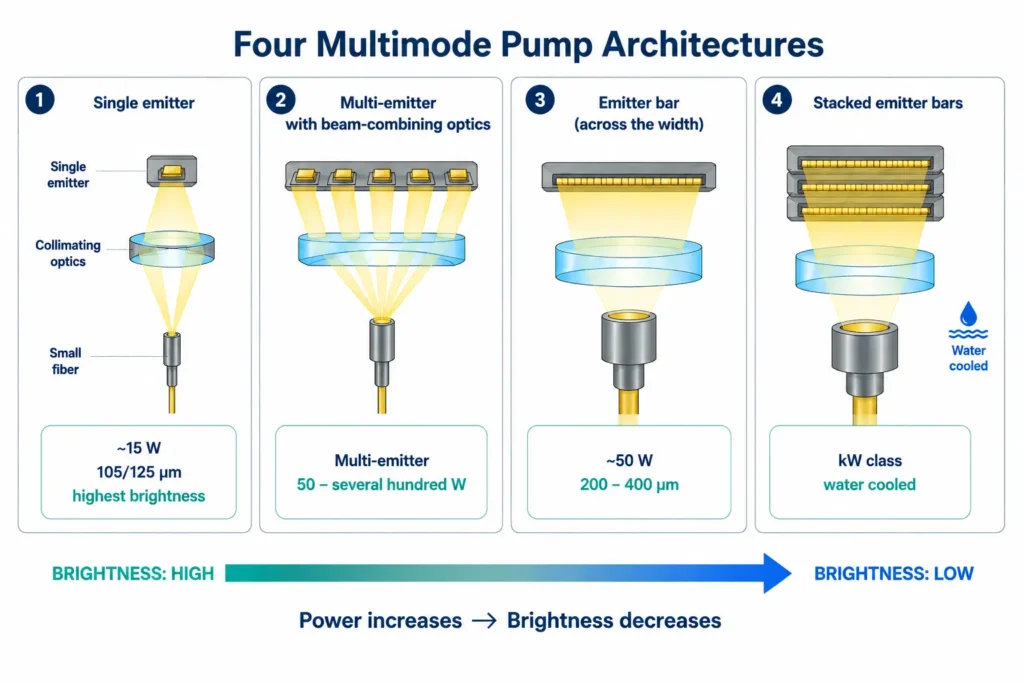
Los módulos de bomba se construyen de cuatro maneras, y las diferencias aparecen en potencia, brillo, costo y cómo fallan.
| Arquitectura | Potencia típica | Fibra de entrega | Carácter |
|---|---|---|---|
| Emisor único | ~10–25 W | 105/125 µm | Mayor brillo por vatio; un emisor, un punto de fallo |
| Módulo multiemisor | ~50–varios cientos de W | 105–200 µm | Varios emisores discretos combinados en haz en una fibra; degradación gradual |
| Barra única | ~50 W | 200–400 µm | Muchos emisores en una barra monolítica; menor brillo, bajo costo por vatio |
| Multibarra / apilado | Cientos de W a kW | 400 µm y mayores | Barras apiladas; mayor potencia, menor brillo, refrigeración por agua típica |
Algunas cosas que vale la pena entender sobre esta tabla.
Los emisores únicos ofrecen el mejor brillo. La salida de un emisor se puede colimar y enfocar en una fibra pequeña con alta eficiencia, por lo que obtienes más vatios por unidad de étendue. Los módulos multiemisor conservan gran parte de eso combinando varios emisores únicos espacialmente y por polarización, razón por la cual dominan el bombeo de láseres de fibra de potencia media.
Las barras intercambian brillo por costo. Una barra agrupa muchos emisores lado a lado en un solo chip. La potencia total es alta y el costo por vatio es bajo, pero los emisores están distribuidos a lo largo de un eje lento amplio, por lo que el acoplamiento en una fibra pequeña es ineficiente. Terminas necesitando una fibra de entrega más grande, lo que limita el diámetro del revestimiento en el que puedes bombear.
El comportamiento ante fallos difiere. En un módulo multiemisor, un emisor muerto te cuesta una fracción de la potencia y el sistema generalmente sigue funcionando. En una barra monolítica, un fallo de un solo emisor puede propagarse. Este es un argumento de fiabilidad que rara vez aparece en las hojas de datos y que importa mucho para sistemas no supervisados o desplegados en campo.
Brillo, NA, y por qué el número de fibra importa
Dos módulos de bombeo pueden decir ambos “50 W” y ser productos completamente diferentes. Lo que los separa es el brillo.
El brillo es la potencia dividida por el producto del área emisora y el ángulo sólido. En términos de acoplamiento por fibra, esto se traduce en potencia dividida por el producto del diámetro del núcleo y la apertura numérica. Un módulo de 50 W en una fibra de 105 µm / 0.22 NA es un dispositivo mucho más útil que 50 W en una fibra de 400 µm / 0.22 NA, aunque la potencia etiquetada sea idéntica.
Dos consecuencias se derivan directamente, y ambas afectan tarde en el diseño si no se presupuestan temprano.
El brillo no se puede mejorar aguas abajo. La óptica puede remodelar un haz, pero el producto del tamaño y la divergencia — étendue, expresado para haces como producto de parámetros de haz — no se puede reducir con óptica pasiva. Si tu bombeo llega con demasiado étendue para el revestimiento interno de tu fibra, ninguna lente lo arregla. Pierdes el exceso como calor en el lanzamiento.
El diámetro del revestimiento es una restricción a nivel de sistema. Un revestimiento interno más grande acepta luz de bombeo de menor brillo más fácilmente, pero también reduce la absorción del revestimiento por unidad de longitud, por lo que necesitas más fibra. Un revestimiento más pequeño absorbe más rápido y ofrece mejor control de modo, pero exige bombas más brillantes. El brillo de la bomba y el diseño de la fibra son una sola decisión, no dos.
La instrucción práctica: nunca aceptes una cifra de potencia de bombeo sin el diámetro del núcleo y la NA adjuntos. La potencia sola no es una especificación.
Estabilización de longitud de onda: qué cuesta realmente y qué compra
Un diodo Fabry-Pérot de área amplia no estabilizado tiene un ancho de línea de varios nanómetros y su longitud de onda central se mueve tanto con la temperatura de la unión (aproximadamente 0.3 nm por °C) como con la corriente de excitación. Para un diseño de 915 nm eso está bien. Para 976 nm en iterbio generalmente no lo está.
Existen tres enfoques.
Estabilización con rejilla de Bragg en fibra (FBG) escribe una rejilla en el pigtail, reflejando una banda estrecha de vuelta al diodo y forzándolo a lase allí. Este es el método dominante para módulos de bombeo acoplados por fibra. Típicamente reduce la emisión por debajo de 0.5 nm y desacopla en gran medida la longitud de onda de la temperatura y la corriente.
Estabilización con rejilla de Bragg de volumen (VBG) coloca una rejilla de volumen como acoplador de salida, generalmente emparejada con una reflectividad frontal reducida para que la rejilla gane la competencia por la ganancia. Común en diseños de espacio libre y a nivel de módulo.
Sin estabilización, emparejada con un control de temperatura estricto o una banda de absorción deliberadamente tolerante. Esta es la ruta de 915 nm, y hecha conscientemente produce el sistema más simple.
Dos detalles que vale la pena conocer antes de especificar una bomba bloqueada.
La longitud de onda de diseño de la rejilla debe estar cerca del pico de emisión natural del chip — dentro de aproximadamente ±5 nm — o el diodo no se bloqueará de manera confiable en su rango operativo. Esta es una restricción del lado de fabricación, pero determina cuánto margen de temperatura tiene realmente un módulo bloqueado.
El bloqueo no es instantáneo. La estabilización basada en FBG tarda un tiempo finito en establecerse después del encendido, porque la luz debe hacer un viaje de ida y vuelta a la rejilla y regresar. Para bombeo de onda continua esto es irrelevante. Para bombeo pulsado o modulado rápidamente, la primera porción de cada pulso puede emitir sin bloquear y espectralmente ancha, lo que afecta la absorción y puede sorprenderte en un diseño QCW.
Introduciendo la bomba en la fibra
Entre el módulo de bombeo y la fibra activa se encuentra un componente que determina silenciosamente gran parte del comportamiento del sistema: el combinador de bombeo.
Un combinador de bombeo-señal toma varias fibras de bombeo multimodo más, generalmente, una fibra de señal a través del centro — las configuraciones (6+1)×1 y (18+1)×1 son comunes — y las afina en una sola fibra de salida de doble revestimiento. La luz de bombeo aterriza en el revestimiento interno; la señal pasa a través del núcleo sin tocarse.
Tres cosas sobre los combinadores que vale la pena conocer al momento de especificar.
La conservación del brillo también se aplica aquí. El afinamiento no puede concentrar la luz de bombeo más allá de lo que permite el étendue. Alimentar un combinador con bombas que son demasiado bajas en brillo para el revestimiento de salida desperdicia potencia como calor justo en el afinamiento — una causa común de combinadores que se calientan.
El número de bombas establece tu granularidad de redundancia. Un combinador (6+1)×1 con seis módulos de bombeo se degrada gradualmente; perder uno cuesta aproximadamente una sexta parte de la potencia de bombeo. Dos módulos muy grandes alimentando un 2+1 te dan un sistema mucho más frágil.
La luz que se propaga hacia atrás es un peligro real. La bomba no absorbida y la señal reflejada hacia atrás viajan hacia las bombas. Los eliminadores de luz de revestimiento y el aislamiento adecuado no son opcionales por encima de niveles de potencia moderados, y los diodos de bomba dañados por reflexión hacia atrás se diagnostican con frecuencia erróneamente como fallas aleatorias.
Empaquetado, unidad e interfaz térmica
El paquete es donde la bomba se encuentra con su diseño mecánico y eléctrico.
Mariposa de 14 pines Los paquetes son el estándar para dispositivos de baja potencia y de modo único, que típicamente integran un TEC y un termistor para que la temperatura de la unión pueda mantenerse activamente. Cuestan espacio en la placa y energía, y el TEC se convierte en un componente en su presupuesto de confiabilidad.
Módulos multimodo acoplados por fibra a decenas o cientos de vatios generalmente se enfrían por conducción a una placa base, con una temperatura máxima de carcasa especificada y resistencia térmica. Por encima de unos pocos cientos de vatios, el enfriamiento por agua es típico.
Eléctricamente, espere que un emisor único requiera aproximadamente 1,5 V a 10–20 A. Los emisores conectados en serie aumentan el voltaje y mantienen la corriente igual; las barras ejecutan matrices paralelas y tiran de 45–60 A a voltajes similares. Las pilas de múltiples barras en serie aumentan el voltaje en consecuencia. La razón para importar es que el voltaje de cumplimiento de su controlador, la estabilidad de corriente y la protección transitoria siguen de esto, y los diodos de bomba no perdonan el sobreimpulso de corriente en el encendido.
Un punto térmico que se subestima: la temperatura de carcasa especificada no es una sugerencia. La temperatura de la unión impulsa la longitud de onda, y la longitud de onda impulsa la potencia absorbida. En un sistema de 976 nm, una interfaz térmica que se degrada con el tiempo — compuesto seco, tornillo flojo, placa fría sucia — se presenta como una disminución lenta de la salida que parece envejecimiento del diodo. A menudo no lo es.
Qué preguntar a un proveedor de bombas
El consejo genérico sobre leer las hojas de datos con escepticismo se aplica. Estas son las preguntas específicas de la bomba.
¿Está especificada la longitud de onda central con una tolerancia y una temperatura de carcasa de referencia? Un “976 nm” desnudo no es utilizable. Necesita el número, la tolerancia y la temperatura a la que se midió.
¿Cuál es el ancho de línea, y está bloqueado el dispositivo? Para 976 nm en iterbio, la respuesta determina si el diseño funciona.
¿Cuál es el núcleo de la fibra de entrega y la NA, y cuál es la potencia medida en el conector? No la potencia del chip, no la potencia previa al acoplamiento. Lo que sale de la fibra que realmente conectará.
¿Se examinó cada unidad con quemado, o solo una muestra? Los láseres de diodo fallan temprano o funcionan durante años. El quemado es cómo se separan esas poblaciones antes del envío, y examinar cada unidad cuesta al proveedor un rendimiento real — por lo que algunos no lo hacen.
¿Es hermético el paquete? La degradación de la faceta por humedad se acumula durante años. Dos módulos pueden verse idénticos en papel y divergir bruscamente en el tercer año.
¿Puede ver datos en toda la ventana operativa? Longitud de onda, potencia y umbral en los extremos de temperatura, no solo a 25 °C.
Nuestro propio flujo para fuentes de bomba de diodo acopladas por fibra ejecuta inspección de entrada, prueba de chip, unión de troquel y ensamblaje de chip sobre submount, acoplamiento y alineación de fibra automatizados, sellado hermético por soldadura de costura paralela, luego quemado y ciclado de alta/baja temperatura antes de la prueba final. La razón para estar verticalmente integrados no es marketing — es que cuando una unidad se comporta de manera extraña, el rastreo hasta un paso de unión o una alineación de acoplamiento realmente existe. Puede revisar el equipo y capacidad de prueba detrás de eso, o explorar módulos de fuente láser disponibles si está evaluando una longitud de onda y potencia específicas.
Errores comunes
Comparar bombas solo por vatios. Sin el diámetro del núcleo y la NA, la cifra de potencia le dice casi nada sobre si el módulo se ajusta a su fibra.
Elegir 976 nm y luego descubrir el presupuesto térmico. La ventaja de eficiencia es real, pero viene acompañada de requisitos de estabilización y enfriamiento. Decida con el costo completo a la vista.
Asumir que el brillo puede recuperarse. No puede. La extensión solo crece a través de ópticas pasivas. Presupueste en la etapa de arquitectura.
Ignorar la protección contra reflexión hacia atrás. Los eliminadores de luz de revestimiento y el aislamiento son estructurales, no accesorios.
Calibrar y calificar solo a temperatura ambiente. La longitud de onda y el umbral se mueven con la temperatura. Una caracterización a 25 °C le dice muy poco sobre un arranque en frío a −20 °C.
Tratar el combinador como plomería pasiva. Su aceptación de brillo, recuento de bombas y manejo térmico dan forma a la confiabilidad del sistema tanto como los diodos.
Preguntas frecuentes
¿Debo usar 915 nm o 976 nm para bombear un láser de fibra de iterbio?
976 nm se asienta en un pico de absorción fuerte y estrecho — mejor eficiencia y fibra más corta, pero necesita estabilización de longitud de onda y control térmico estricto. 915 nm se asienta en una característica amplia y débil — menor eficiencia y fibra más larga, pero tolerante a la deriva y más suave térmicamente. Los entornos controlados favorecen 976; los despliegues robustos favorecen 915.
¿Qué es una bomba estabilizada por rejilla de Bragg en fibra?
Un diodo de bomba con una rejilla escrita en su fibra de entrega que refleja una banda estrecha de vuelta al diodo, forzándolo a lase a esa longitud de onda. Típicamente estrecha la emisión por debajo de 0,5 nm y mantiene la longitud de onda en gran medida independiente de la temperatura y la corriente de manejo — esencial para el bombeo de iterbio a 976 nm.
¿Cuál es la diferencia entre un emisor único y una barra láser?
Un emisor único es una franja emisora, típicamente de 10–25 W, con alto brillo y fácil acoplamiento en una fibra de 105 µm. Una barra empaqueta muchos emisores en un solo chip para alrededor de 50 W a menor costo por vatio, pero el área emisora amplia reduce el brillo y requiere una fibra de entrega más grande.
¿Por qué importa el brillo de la bomba si solo necesito potencia total?
Porque el brillo determina si esa potencia puede lanzarse al revestimiento interno de su fibra en absoluto. La óptica pasiva no puede reducir la extensión, por lo que la luz de bomba que es demasiado divergente para el revestimiento se pierde como calor en el lanzamiento, independientemente de cuántos vatios comenzó.
¿Qué es el bombeo de revestimiento?
Lanzar luz de bombeo hacia un gran revestimiento interno multimodo en lugar del pequeño núcleo dopado. La bomba cruza el núcleo repetidamente a lo largo de metros de fibra y se absorbe gradualmente, lo que permite que diodos multimodo de baja luminosidad produzcan una salida de modo único. Es la base de esencialmente todos los láseres de fibra de alta potencia.
¿Los diodos de bomba necesitan un TEC?
Depende de la longitud de onda. Una bomba estabilizada o de 915 nm a menudo funciona con enfriamiento por conducción pasiva con una temperatura de carcasa especificada. Una bomba no estabilizada de 976 nm hacia iterbio generalmente necesita control activo de temperatura para permanecer en el pico de absorción.
Especificando la bomba junto con la fibra
La longitud de onda de la bomba, el brillo de la bomba, el diámetro del revestimiento y la longitud de la fibra son una decisión acoplada. Resolverlos de forma independiente es cómo los programas terminan con un combinador que se calienta y una cifra de eficiencia que nadie puede explicar.
Envíenos su fibra de ganancia, requisito de salida y envolvente térmica, y nuestros ingenieros trabajarán con usted en las opciones de bomba — incluyendo si la estabilización justifica su costo en su plataforma, y qué deben mostrar los datos de longitud de onda versus temperatura para que su presupuesto de absorción se cierre.
Referencias
- Scientific Reports — Oscilador de fibra de kilovatios bombeado a 915 nm con alta eficiencia óptica a óptica
- Coherent — Láser de fibra de alta potencia para procesamiento de materiales de calidad
- Optics Express — Láser de fibra dopado con iterbio de alta potencia y onda continua, sintonizable de 976 a 1120 nm