


Most pump wavelength decisions get made backwards. Someone picks 808 nm because the last three builds used 808 nm, the crystal absorbs it, and the diodes are cheap. Then the thermal lens shows up at 60% of design power, the beam quality falls apart, and the fix becomes a bigger heatsink instead of a different pump.
The cost of that shortcut is real. Every watt you put in at the wrong wavelength becomes heat inside the gain medium, and heat inside the gain medium is what limits your output power, your M², and your pointing stability. You cannot cool your way out of a wavelength choice.
Two numbers settle most of this before you order anything: the quantum defect, and the fluorescence lifetime of the gain medium. Both come straight out of the physics of fluorescence, and both are printed on data you already have.
Table of Contents
Pump wavelength selection comes down to two quantities. The quantum defect (1 − λ_pump/λ_laser) sets how much pump power becomes heat inside the crystal. The fluorescence lifetime of the upper laser level sets how much energy the medium can store between pulses. Pick the longest pump wavelength the medium will still absorb efficiently, then verify the diode holds that wavelength across your full thermal range.
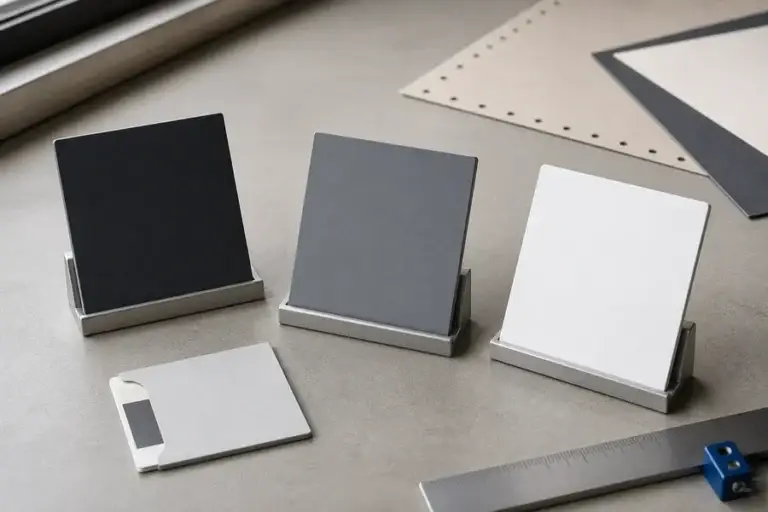
[ IMAGE 1 — replace this paragraph with the image block ]
Shot: Hero image — a row of LUMEXIS fiber-coupled diode laser modules (808, 888, 976 nm) laid out on a neutral bench with their delivery fibers coiled, plus a small Nd:YVO4 crystal on a mount in the foreground.
File: lumexis-pump-wavelength-selection-1.webp
Alt: Fiber-coupled diode laser pump modules at 808, 888 and 976 nm beside an Nd:YVO4 laser crystal
Quantum defect is heat you designed in
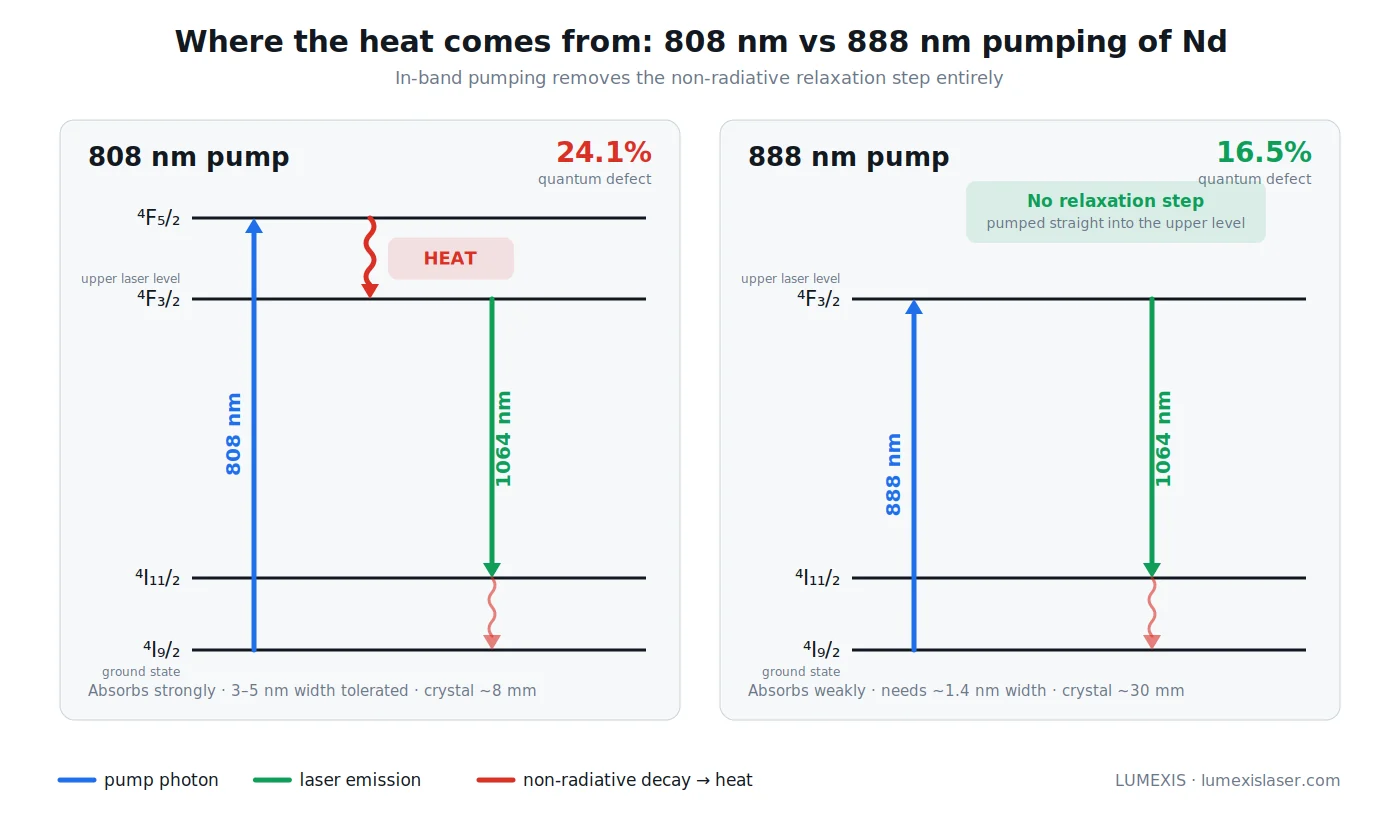
When a pump photon is absorbed, the ion climbs to an excited state. It does not stay there. It relaxes down to the upper laser level, dumping the energy difference into the crystal lattice as phonons, and only then does it emit a laser photon. That relaxation step is invisible on a datasheet and unavoidable in the physics.
The arithmetic is simple. Pump at 808 nm for 1064 nm output and the fractional loss is 1 − 808/1064, or about 24%. Pump the same transition at 888 nm and it drops to 16.5%. Nothing else in the system changed. You just deleted about a third of the thermal load.
| Pump λ | Laser λ | Quantum defect | Typical medium |
|---|---|---|---|
| 808 nm | 1064 nm | 24.1% | Nd:YAG, Nd:YVO₄ |
| 878.6 nm | 1064 nm | 17.4% | Nd:YVO₄ (in-band) |
| 885 nm | 1064 nm | 16.8% | Nd:YAG (in-band) |
| 888 nm | 1064 nm | 16.5% | Nd:YVO₄ (in-band) |
| 915 nm | 1070 nm | 14.5% | Yb-doped fiber |
| 976 nm | 1070 nm | 8.8% | Yb-doped fiber |
| 976 nm | 1030 nm | 5.2% | Yb:YAG, Yb fiber |
That last row is why ytterbium became the workhorse of high-power fiber lasers. A 5% thermal fraction is a different engineering problem from a 24% one.
The catch is that lower quantum defect almost always means weaker absorption. Neodymium’s absorption peak at 888 nm is a small fraction of the height of the 808 nm peak. You get the thermal benefit by accepting that the pump light travels further before it is absorbed, which means a longer crystal, higher doping, or both. In practice, in-band pumped rods commonly run near 30 mm where an 808 nm design would top out around 8 mm. That is a real change to your cavity layout, not a drop-in substitution.
Fluorescence lifetime decides what pulse format you can build
The second number is the upper-state lifetime, sometimes called the fluorescence lifetime. It is how long an excited ion waits, on average, before it gives its photon back spontaneously. It tells you how long the medium will hold energy for you.
For continuously pumped Q-switched lasers, this is the whole game. A long lifetime lets you accumulate population between pulses and dump it in one shot. A short lifetime means the energy leaks away as fluorescence before your Q-switch opens.
| Medium | Fluorescence lifetime | What it implies |
|---|---|---|
| Nd:YVO₄ | 90–100 µs | High gain, low storage. Suits high rep rate, modest pulse energy. |
| Nd:YAG | ~230 µs | Balanced storage. The default for Q-switched work. |
| Nd:YLF | ~480 µs | Better storage, weaker thermal handling. |
| Yb-doped fiber | ~800 µs–1 ms | Long storage, but needs in-band pumping by nature. |
| Er:glass (1535 nm) | milliseconds | Very long storage. Enables compact, low-average-power ranging sources. |
Nd:YVO₄ illustrates the trade cleanly. Its emission cross-section is roughly five times that of Nd:YAG, which gives you high gain and a low threshold, but its lifetime is less than half. Great for a 100 kHz marking laser. Poor for a 10 Hz high-energy pulse.
Lifetime also constrains how you pump. If you are running QCW pumping, a pump pulse much longer than the fluorescence lifetime is wasted energy: the front of your pump pulse has already fluoresced away before the back of it arrives. Match the pump pulse duration to the storage time, or accept the loss knowingly.
Neodymium: three in-band options that are not interchangeable
Once you decide to move off 808 nm, you face a choice between 878.6, 885 and 888 nm. Suppliers list them side by side as if they were variants. They solve different problems.
878.6 nm pumps Nd:YVO₄ directly into the upper laser level. Of the three it demands the tightest wavelength control, because the absorption feature it targets is narrow. Our 878.6 nm fiber-coupled series is specified at 878.1–879.1 nm with a temperature drift of 0.015 nm/°C, which is the tightest figure in our pump catalog. That number exists because the application cannot tolerate anything looser.
885 nm is the Nd:YAG counterpart, targeting the ⁴I₉/₂ to ⁴F₃/₂ transition directly. Same logic, different host.
888 nm does something the other two do not. At 888 nm, Nd:YVO₄ absorbs almost identically for light polarized along the a- and c-axes. Polarization-independent absorption means you can pump unpolarized fiber-delivered light into the crystal without worrying about orientation or depolarization in the delivery fiber, and the absorbed power distribution stays predictable. For high-power TEM₀₀ designs that is worth more than the extra 0.9% of quantum defect saved.
| 808 nm | 878.6 nm | 885 nm | 888 nm | |
|---|---|---|---|---|
| Typical target | Nd:YAG, Nd:YVO₄ | Nd:YVO₄ | Nd:YAG | Nd:YVO₄ |
| Absorption strength | Strong | Weak | Weak | Weakest |
| Spectral width required | 3–5 nm acceptable | ~1 nm | ~1 nm | ~1.4 nm |
| Typical drift spec | 0.3–0.4 nm/°C | 0.015 nm/°C | 0.02 nm/°C | 0.02 nm/°C |
| Polarization sensitive | Yes | Yes | Yes | Largely no |
| Crystal length | Short (~8 mm) | Long | Long | Long (~30 mm) |
The pattern to read here: the in-band wavelengths buy thermal headroom with wavelength discipline. If your build cannot hold the diode wavelength, in-band pumping will underperform plain 808 nm.
Ytterbium: 915 nm and 976 nm are two different design philosophies
For Yb-doped fiber, the choice is not subtle, and the reason has nothing to do with quantum defect alone.
Ytterbium’s 976 nm absorption peak is tall and narrow, only a few nanometers wide. Its 915 nm shoulder is short and broad, comfortably tens of nanometers. That single difference drives everything downstream.
Run the arithmetic that most selection guides skip. An unstabilized Fabry-Pérot diode drifts roughly 0.35 nm/°C. Across a 20 °C swing in coolant temperature, that is 7 nm of wander. A 976 nm peak a few nanometers wide simply will not survive that: the diode walks off the absorption feature and your pump power passes straight through the fiber to the cladding stripper. The same 7 nm of drift on the 915 nm shoulder changes absorption by a few percent and nothing bad happens.
So a stabilized 976 nm pump is not a premium feature. It is a requirement. Our 976 nm A-series is locked to 975.5–976.5 nm with 0.8 nm spectral width and 0.02 nm/°C drift, against a broad C-series at 973–979 nm with 5–6 nm width and 0.3–0.4 nm/°C for applications that do not need the peak.
Choose this way:
- 976 nm stabilized when efficiency and short absorption length matter more than thermal simplicity: kilowatt-class oscillators, short active fibers, systems with tight coolant control.
- 915 nm when you want tolerance: forgiving thermal environments, long absorption lengths that spread the heat load along the fiber, TEC-less operation, and lower cost per watt.
The 915 nm option deserves more credit than it usually gets. Spreading pump absorption over a longer fiber lowers the peak thermal load per unit length, which is exactly what you want when transverse mode instability is your ceiling rather than raw efficiency.
Thulium at 793 nm: where the quantum defect number lies to you
If you take the formula literally, pumping a 1940 nm thulium laser at 793 nm looks terrible. The quantum defect is nearly 59%. On paper the crystal should cook.
It does not, because of cross-relaxation. One absorbed 793 nm photon can produce two excited ions in the upper laser manifold, pushing quantum efficiency toward 200% and cutting the effective thermal fraction to something closer to 18%. This is a case where the energy-level structure beats the wavelength arithmetic, and it is why 793 nm remains the standard pump for Tm-doped fiber despite the raw numbers.
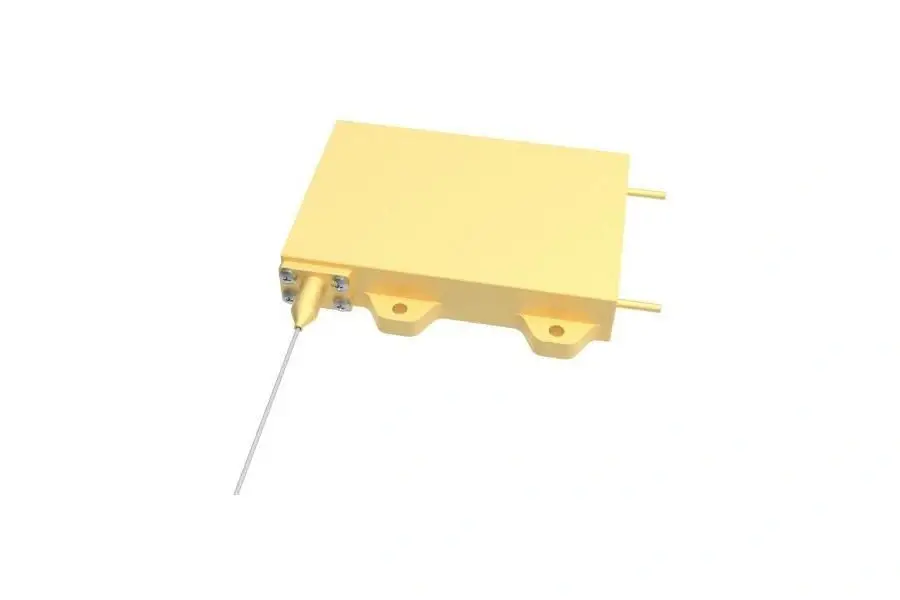
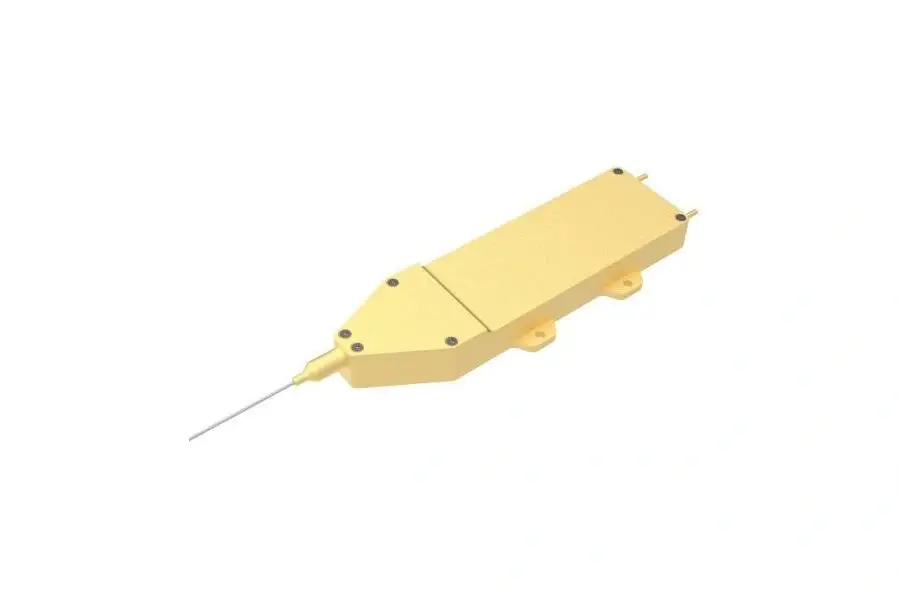
Watch the back-reflection specification here. Thulium systems send 2 µm light back down the delivery fiber, and a pump module without isolation in the 1850–2100 nm band will degrade. Our 792 and 793 nm modules carry that isolation for exactly this reason. It is the kind of line item that never appears in a wavelength comparison table but ends warranties.
Erbium glass at 1535 nm: paying a large defect on purpose
Pump an erbium-glass source at 976 nm to emit at 1535 nm and you accept a 36% quantum defect. No in-band alternative fixes it at that scale.
You take the hit because 1535 nm sits in the eye-safe band under IEC 60825, where the maximum permissible exposure is orders of magnitude higher than at 1064 nm. For a handheld or UAV-mounted rangefinder, that classification is the product requirement. Efficiency is negotiable; eye safety is not.
The fluorescence lifetime is what makes the trade survivable. Erbium in glass holds energy for milliseconds rather than microseconds, so a small, low-average-power pump diode can slowly fill the medium and a Q-switch can release it as a millijoule-class pulse. That storage behavior is the reason a 5 km rangefinder fits in a hand.
Reading a pump diode datasheet skeptically
Four lines decide whether a pump module will do in your system what it did on the supplier’s bench.
The drift specification, not the center wavelength. A center wavelength is measured at one case temperature. Multiply the drift coefficient by your actual operating window and see where the wavelength lands at both ends. If the result leaves the absorption feature, the center wavelength was never the relevant number.
The power range over which the lock holds. Wavelength-stabilized modules typically guarantee the lock between about 30% and 100% of rated power. Below that floor the grating can stop dominating and the diode reverts to free-running behavior. If your system dims the pump during warmup or standby, verify what happens down there.
Back-reflection isolation band. Ask which wavelengths are isolated, not whether isolation exists. An 808 nm pump for Nd needs protection around 1030–1200 nm. A thulium pump needs 1850–2100 nm. They are not the same part.
Core diameter and NA against your actual coupling. A 200 µm core at 0.22 NA and a 105 µm core at the same power are different beams entering your crystal. The smaller core concentrates pump intensity, which raises gain and also raises local thermal gradient. Match it to the mode you are trying to pump, not to whichever is in stock.
How we approach this
We build pump sources for people who are designing a laser, not buying a finished one, so the conversation usually starts with the gain medium rather than a part number. What host, what doping, what pulse format, what coolant range. The wavelength falls out of those answers.
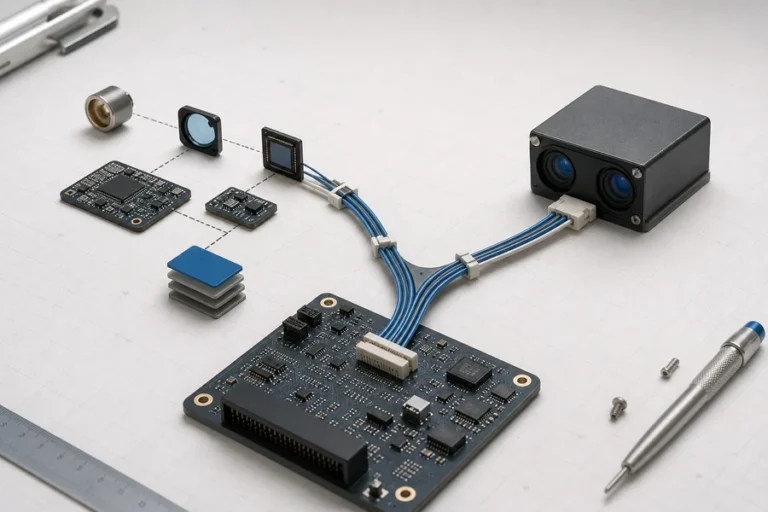
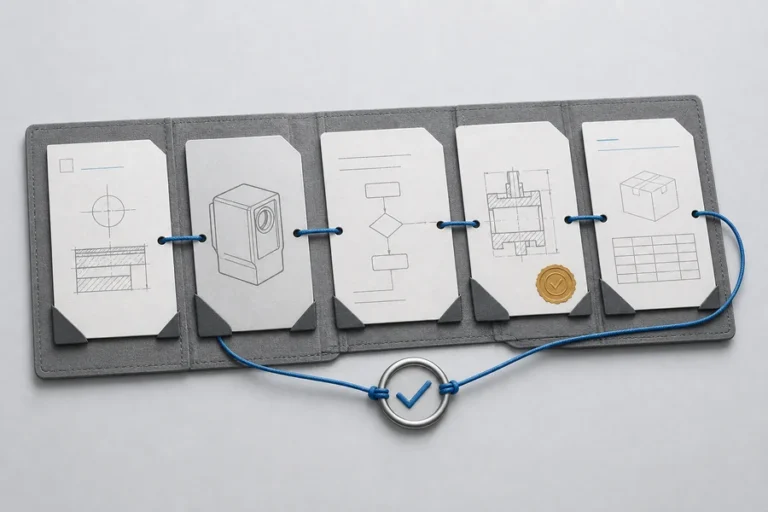
The specifications that make in-band pumping work are manufacturing outcomes, not marketing claims. A 0.015 nm/°C drift figure depends on how the grating is bonded and how the package is sealed. Our production flow runs incoming inspection, chip test, die bonding, fiber coupling and alignment, hermetic seam welding, then burn-in screening and full temperature cycling before final test. Early-life failures get screened on COS aging systems rather than discovered in your field units. That is what stands behind a locked wavelength spec.
If you are still deciding, our laser pumping solutions page maps the wavelength families against gain media and typical system classes.
A working order of operations
- Fix the gain medium and output wavelength first. Everything else follows.
- Compute the quantum defect for each candidate pump wavelength. Note the thermal fraction difference in watts, not percent, at your design power.
- Check the fluorescence lifetime against your pulse format. Confirm your pump pulse duration and rep rate make sense against the storage time.
- Find the absorption bandwidth of the target feature. Compare it to diode drift across your real temperature window.
- Decide whether you can accommodate the longer absorption length that in-band pumping requires. If you cannot lengthen the crystal or raise the doping, stay at 808 nm and manage the heat.
- Specify isolation band, lock range, core, and NA before requesting a quote.
FAQ
What is the quantum defect in a laser?
The quantum defect is the fraction of pump photon energy lost as heat rather than converted to laser output, calculated as 1 − λ_pump/λ_laser. Pumping Nd:YAG at 808 nm for 1064 nm output gives 24%. Pumping the same output at 888 nm gives 16.5%. The difference appears directly as reduced thermal load in the crystal.
Why use 888 nm instead of 808 nm for Nd:YVO₄?
Three reasons: about a third less heat generated in the crystal, absorption that is nearly independent of polarization so unpolarized fiber-delivered pump light works predictably, and weaker absorption that allows longer crystals with gentler thermal gradients. The cost is a tighter wavelength requirement and a longer gain element.
Is 915 nm or 976 nm better for pumping ytterbium fiber?
Neither is universally better. 976 nm gives higher efficiency and shorter absorption length but needs a wavelength-stabilized diode because Yb’s absorption peak there is only a few nanometers wide. 915 nm absorbs more weakly across a much broader band, tolerates thermal drift, and spreads heat along a longer fiber.
What does fluorescence lifetime tell you about a gain medium?
It tells you how long the medium stores energy before spontaneous emission releases it. Long lifetimes such as erbium glass in the millisecond range support high pulse energy from modest pump power. Short lifetimes such as Nd:YVO₄ at 90–100 µs favor high repetition rate over high per-pulse energy.
Do I need a wavelength-stabilized pump diode?
You need one whenever the absorption feature you are targeting is narrower than the wavelength wander across your operating temperature range. Multiply the drift coefficient by your temperature window first. In-band Nd pumping and 976 nm Yb pumping almost always require stabilization; 808 nm and 915 nm frequently do not.
Does a lower quantum defect always mean higher efficiency?
No. Lower quantum defect reduces the thermal fraction, but if the weaker absorption at that wavelength leaves pump light unabsorbed, total efficiency can drop. Thulium at 793 nm shows the reverse case: a large quantum defect offset by cross-relaxation that produces two excited ions per pump photon.
Next step
Send us your gain medium, target output wavelength, pulse format, and coolant temperature range. Our engineers will come back with the wavelength options that actually fit, including the ones we do not sell if that is the right answer. Start a technical conversation.
References
- RP Photonics Encyclopedia — Fluorescence
- RP Photonics Encyclopedia — In-band Pumping and Upper-state Lifetime
- McDonagh, Knappe et al., “888-nm pumping of Nd:YVO₄ for high-power high-efficiency TEM₀₀ lasers,” Proc. SPIE 6451 (2007)
- Laser Focus World — Enhance your Nd-doped DPSS laser with a longer-wavelength pump
- IEC 60825-1, Safety of laser products — equipment classification and requirements