

Ask a room of engineers whether a laser rangefinder works at night and you will get a confident yes, a hesitant maybe, and someone who mentions their golf rangefinder failing at dusk.
All three are responding to different things. The physics is not ambiguous. The confusion comes from conflating the measurement with the aiming, and from consumer devices whose limitation was never the laser at all.
This article separates those. It covers why darkness helps rather than hurts ranging performance, what genuinely limits night operation, and what to specify if your product has to work after sunset.
Table of Contents
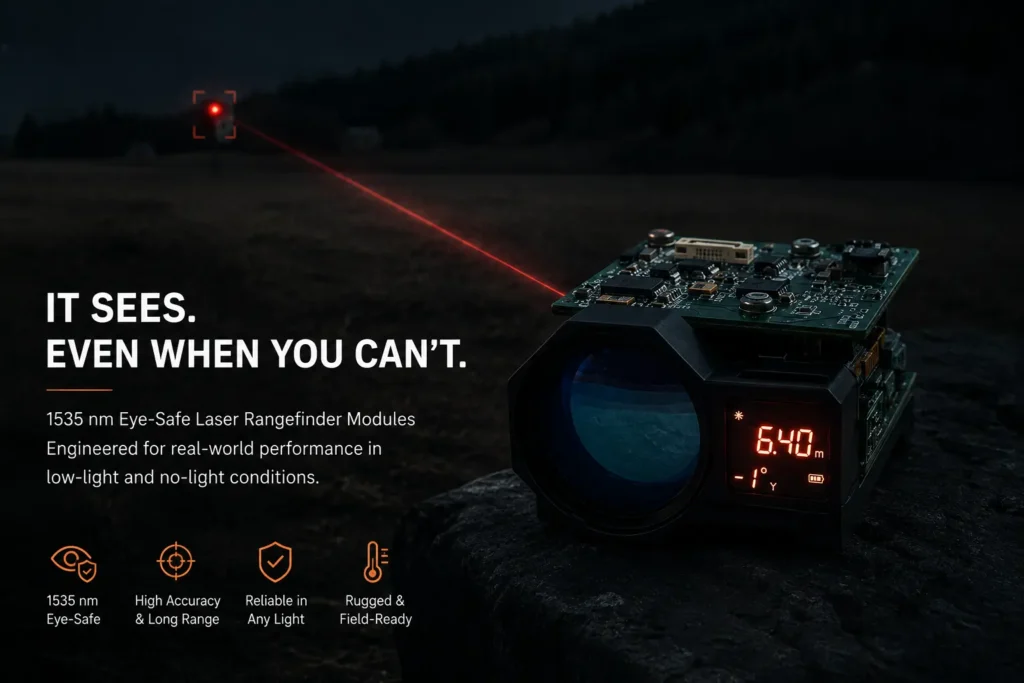
Yes. Laser rangefinders work in complete darkness, because they supply their own illumination — the device emits a laser pulse and times its return, with no dependence on ambient light. Performance usually improves at night, since darkness removes the solar background noise that competes with the return signal during the day. Understanding how Laser Rangefinders Work in the Dark is essential for their effective use. This is because Laser Rangefinders Work in the Dark, allowing for accurate measurements even in low-light conditions.
Why darkness helps laser rangedinder works better
A laser rangefinder is an active sensor. It transmits a pulse and measures the round-trip time of the reflection. Nothing in that chain requires the sun, a streetlight, or anything else the environment provides. A camera is passive and needs light to exist. A rangefinder brings its own.
Which means the interesting question is not whether it works in the dark, but why it works better.
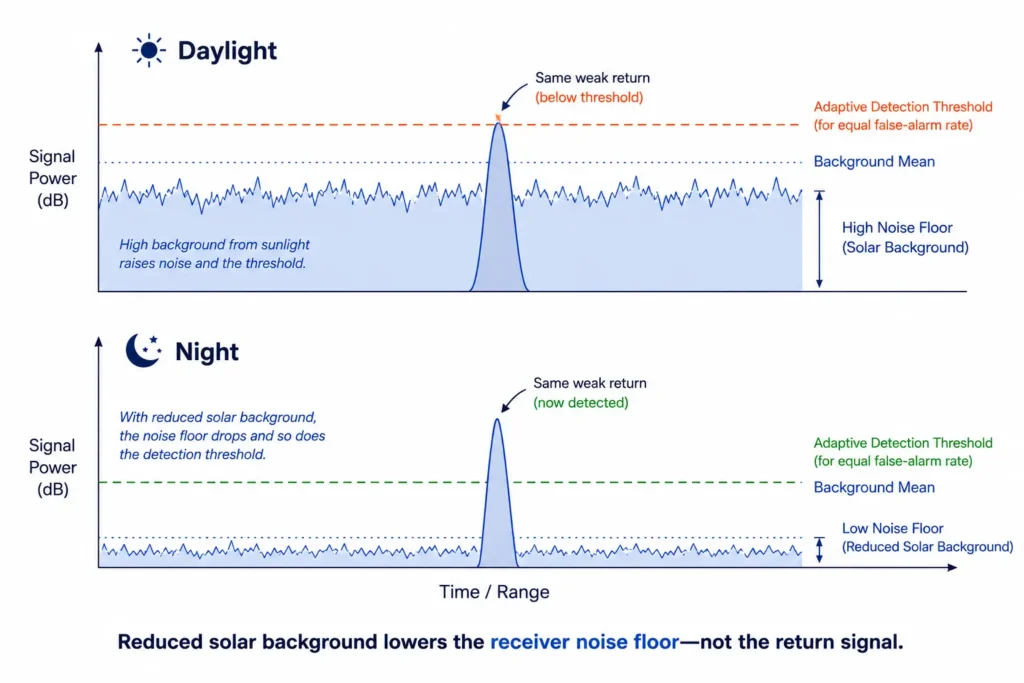
The answer is background noise. During daylight, sunlight floods the receiver across a broad spectrum. Some of it falls inside the receiver’s passband no matter how narrow the optical filter is, and it arrives as a continuous photocurrent that the weak return pulse has to be distinguished from. That background sets the detection threshold. Raise the noise floor and you must either raise the threshold — losing weak returns from distant or dark targets — or accept more false detections.
Remove the sun and the noise floor drops sharply. The same laser, the same detector, the same threshold logic now finds returns it could not see at noon. In practice this often means measurably longer maximum range at night against the same target.
Anyone who has run field tests across a full day knows this pattern: the numbers at 2 p.m. against a bright sky are the worst of the day, and the numbers after dark are the best.
So what actually limits night operation?
Three things, and only one of them has anything to do with the laser.
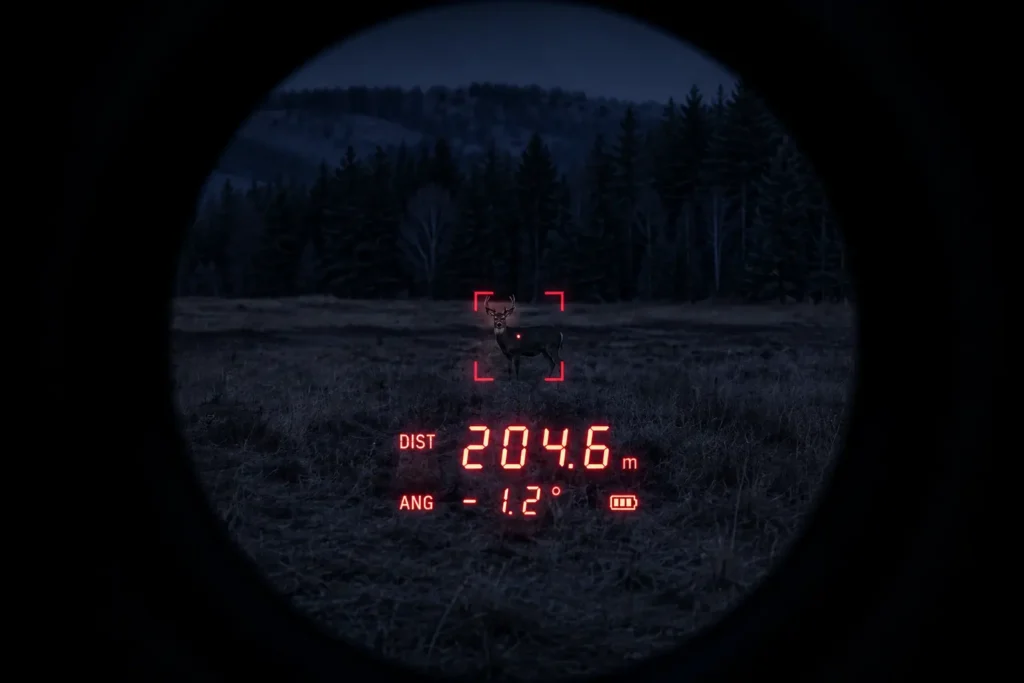
Aiming. This is the real answer to almost every “my rangefinder didn’t work at night” story. Most infrared rangefinders emit at wavelengths invisible to the eye, so you cannot see where the beam is pointing. In daylight you aim through an optical sight at a target you can see. At night, you may not be able to see the target at all. The device is perfectly capable of measuring the distance to that treeline — you simply cannot tell whether you are pointed at it.
This is a human-interface problem, not an optical one, and it is solved with a human-interface answer: an illuminated reticle, a backlit display, a visible aiming laser, or integration with a thermal or night-vision channel so the operator sees the target the rangefinder is already able to measure.
Target reflectivity. Reflectivity is the dominant range limiter, day or night, and it does not change when the sun goes down. A matte black surface, wet asphalt at a shallow angle, or dark foliage returns a small fraction of the incident light. This is often blamed on darkness because both problems show up in the same conditions, but a black target is equally difficult at noon.
The confusion is understandable and worth being precise about: darkness reduces noise, it does not increase signal. If the return is weak because the target absorbs your wavelength, night helps only to the extent that the lower noise floor lets you detect a weaker return. It helps, but it does not rescue a fundamentally poor return.
Weather. Fog, rain, snow, and dust scatter and absorb the outgoing pulse and the return. Fog in particular also backscatters energy straight into the receiver, producing false short-range returns that can mask the real target. This is independent of light level — night fog and day fog are equally hostile — but night operations tend to coincide with the conditions that produce fog, which is why the two get associated.
Wavelength changes the picture
Not every rangefinder handles darkness the same way, and the differences trace back to wavelength.
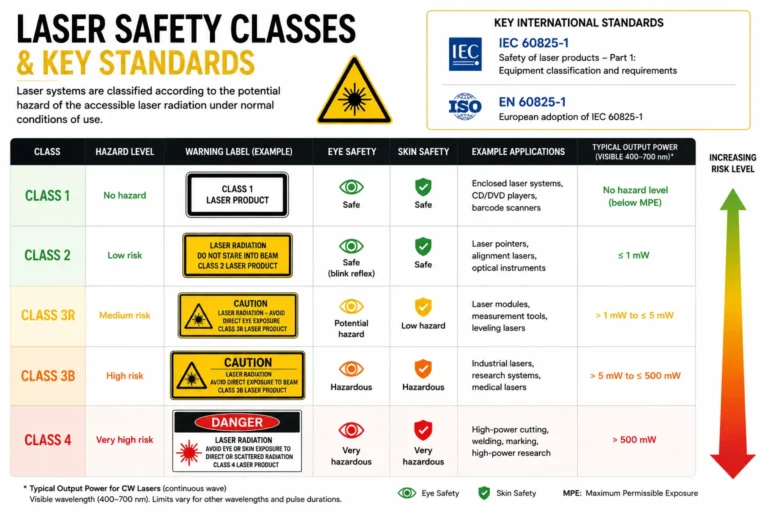
905 nm silicon-detector systems are inexpensive and common. They sit inside the eye’s retinal hazard region, so eye-safety limits cap the pulse energy a Class 1 product may transmit — which caps range regardless of lighting. They benefit from reduced night background like everything else, but they start from a lower energy ceiling.
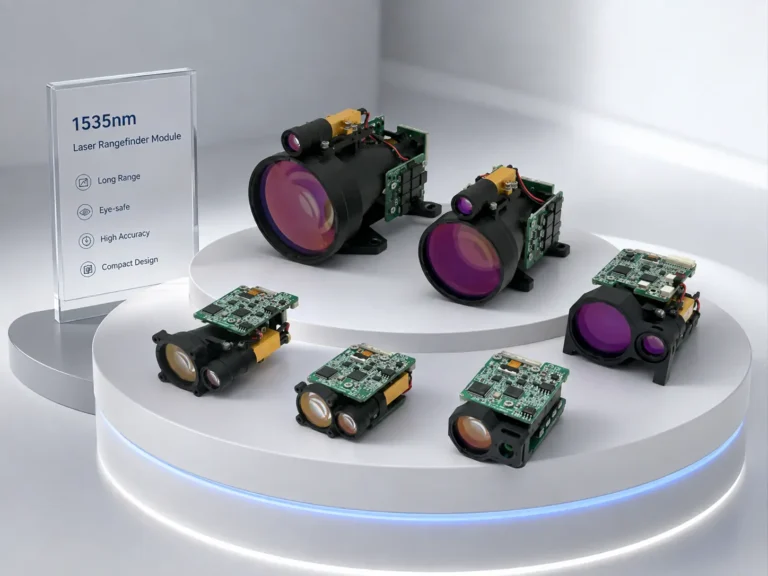
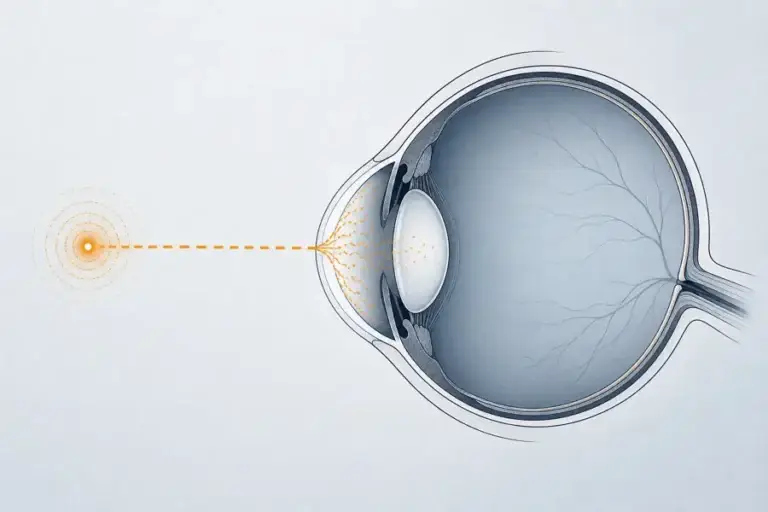
1535 nm and 1570 nm erbium-based sources clear the retinal hazard region because the light is absorbed at the cornea before reaching the retina. Permissible exposure is far higher, so a Class 1 device can put substantially more energy downrange. The result is longer range in every condition, and it stacks with the night noise advantage.
There is a second benefit at 1.5 µm that matters specifically for night operations. Solar irradiance is lower in that band than around 900 nm, and atmospheric water absorption further reduces the solar background reaching the detector. So a 1535 nm system starts with a better daytime signal-to-background ratio and then gains again after sunset.
The trade remains the detector. InGaAs costs more than silicon and behaves differently on noise. For a consumer golf rangefinder that is decisive. For a UAV altimeter, a border surveillance system, or a vehicle-mounted sight that must work at 3 a.m. against a dark target, the calculation usually goes the other way. We work through this trade regularly with integrators specifying ranging and sensing solutions, and it is worth settling before the detector and optics are locked.
What changes in a module built for night work
If a system’s mission includes darkness, a few design details separate the units that hold up from the ones that disappoint.
Receiver bandwidth and filtering should be matched tightly to the emission line. A narrow optical bandpass filter is what rejects background in daylight, and the tighter it is, the better both day and night performance become. The catch is that the laser’s center wavelength must stay inside that filter passband across the full temperature range — which loops directly back to source stability.
Emission wavelength stability over temperature is therefore not a cosmetic spec. Night operations frequently mean cold operations. If your source drifts off the receiver’s filter passband at −30 °C, the system quietly loses sensitivity exactly when the mission needs it. This is a common and frustrating failure mode because it looks like a receiver problem.
Trigger-to-emission delay stability determines whether your range calibration holds as the unit cools through a night’s operation. Calibrate at 25 °C, deploy at −20 °C, and an uncompensated delay drift becomes a systematic range offset.
Pulse energy consistency matters because threshold detection on weak returns is where night ranging lives. Shot-to-shot energy variation directly widens the spread of your longest-range measurements.
These are the reasons our team qualifies ranging sources across the full operating window rather than at ambient — burn-in screening to catch early-life failures, then high/low temperature cycling to confirm that wavelength, pulse energy, and timing all stay inside spec at the cold end. You can see the test and qualification process behind that. For fixed-installation work like infrastructure and railway inspection, where systems run unattended through night temperature swings, this is usually the difference between a sensor that holds calibration and one that needs seasonal re-tuning.
Practical checks before you trust a night specification
Ask what the quoted range means. A maximum range figure without target reflectivity, atmospheric visibility, and lighting conditions is marketing, not engineering. Ask for range against a 10% reflectivity diffuse target, and ask under what visibility.
Ask whether the night figure was measured or extrapolated. Reduced background noise is real, but the size of the improvement depends on the receiver design. A supplier who has measured it can tell you the number.
Check the cold-temperature data. Not the storage range — the operating data. Emission wavelength, pulse energy, and timing delay at the cold limit.
Look at the aiming solution, not just the ranging. If your operator cannot confirm the target, ranging capability is irrelevant. Decide early whether you need an illuminated reticle, a visible pointer, or fusion with a thermal channel.
Test in fog if fog is in your environment. Backscatter-induced false returns are a design problem with real solutions — range gating, multi-echo processing — but only if you know you need them.
Frequently asked questions
Do laser rangefinders need light to work?
No. A rangefinder emits its own laser pulse and measures the round-trip time of the reflection, so it is entirely independent of ambient light. It works identically in bright sun, at dusk, and in total darkness — the physics does not change.
Do rangefinders work better at night?
Usually yes. Sunlight adds background noise to the receiver during the day, forcing a higher detection threshold. At night that background largely disappears, so weaker returns become detectable and effective maximum range often increases against the same target.
Why did my rangefinder fail at night then?
Almost always aiming, not ranging. Infrared beams are invisible and distant targets are hard to see in the dark, so the device may be measuring something other than what you intended — or nothing at all. An illuminated reticle, backlit display, or night-vision integration solves it.
Does target color matter more at night?
No, but it becomes more noticeable. Reflectivity limits return strength equally at all hours; a matte black target is difficult at noon too. Darkness lowers the noise floor, which helps marginal returns, but it cannot compensate for a target that absorbs most of your wavelength.
Can laser rangefinders see through fog or rain?
Only to a limited extent. Fog and heavy rain scatter and absorb the beam, and fog backscatters energy into the receiver, which can produce false short-range readings. This is unrelated to darkness — daytime fog is just as limiting.
Is a 1535 nm rangefinder better at night than 905 nm?
Generally yes. Eye-safety limits allow far more pulse energy at 1535 nm, and solar background is lower in that band. The combination gives longer range in daylight and a further advantage after dark. The trade is a more expensive InGaAs detector.
Specifying for the conditions you will actually operate in
If your product has to work at night, define the hardest realistic case first: the darkest target, the coldest temperature, the worst visibility, and the longest range you need simultaneously. Those four together determine wavelength, pulse energy, and receiver design far more usefully than a headline range figure.
Send us that worst case and our engineers will work through the source options with you — including what the cold-end wavelength and timing data needs to look like for your calibration to hold through a night’s operation.
References
- International Electrotechnical Commission — IEC 60825-1, Safety of laser products: Equipment classification and requirements
- RF Wireless World — Direct vs. Indirect Time-of-Flight (ToF) Sensors
- ABTC — The Capabilities and Limitations of Rangefinders
- Occupational Safety and Health Administration — Laser Hazards: Standards