

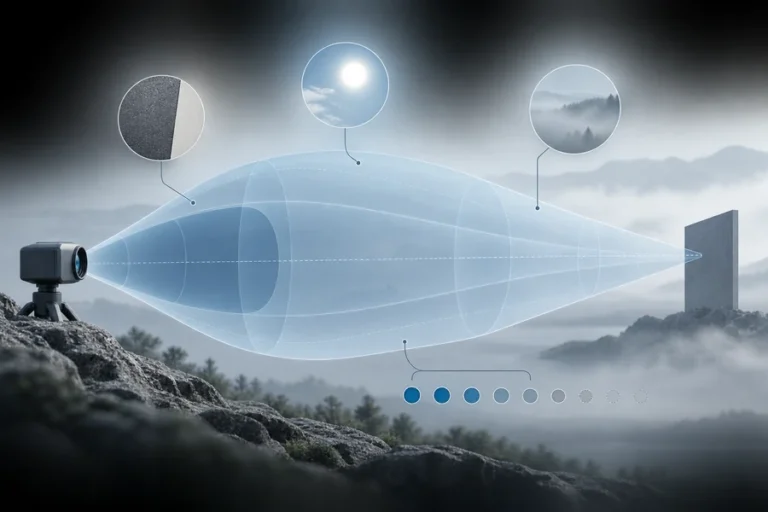

A laser module passes every optical and electrical test on your bench. Range is on spec, pulse energy is stable, beam quality is clean. Then it reaches compliance review and the project stops for six weeks, because nobody decided early on whether the finished product would be Class 1 or Class 3B — and the answer changes the enclosure, the interlocks, the labels, and the export paperwork.
That sequence is common, and it is expensive. Laser safety is not a certification you bolt on before shipping. It is a set of design constraints that should shape wavelength selection, pulse energy, and beam divergence during the first architecture review.
This guide covers what the standards actually require, how classification works in practice, and how the choices you make at the source level determine the safety burden your whole system carries.
Table of Contents
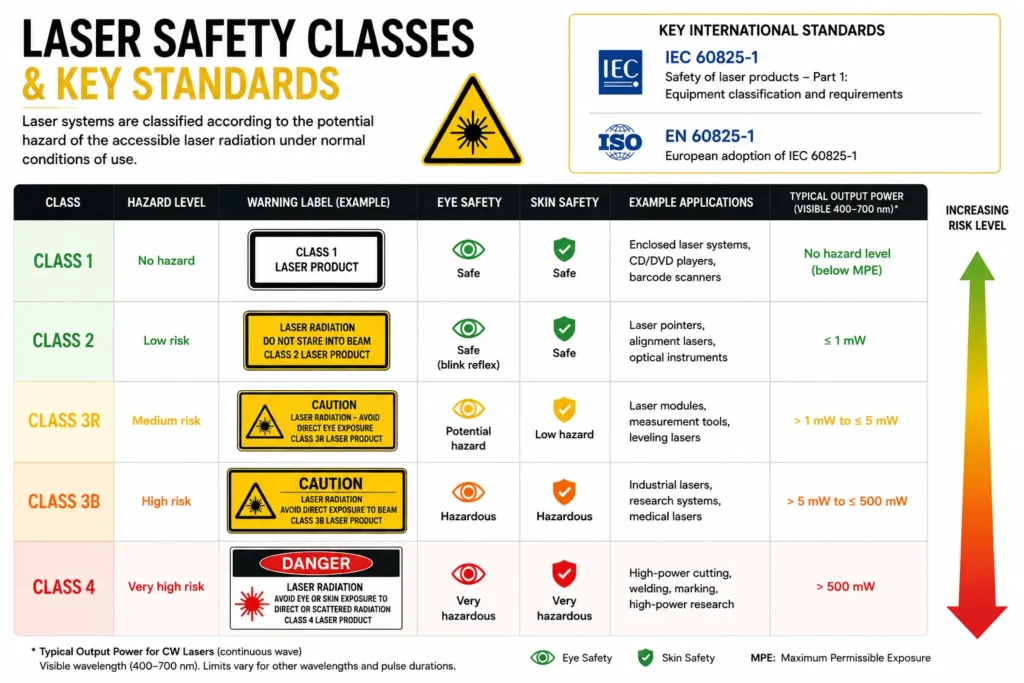
Laser safety standards define how laser products are classified by hazard level and how that hazard must be controlled. IEC 60825-1 is the international product standard that assigns Classes 1, 1M, 2, 2M, 3R, 3B, and 4 based on accessible emission limits. ANSI Z136.1 is the US standard governing safe laser use, built around maximum permissible exposure values.
The two standards that matter, and how they differ
Most engineers hear “laser safety” and picture a single rulebook. There are two, they were written for different readers, and confusing them causes real problems.
IEC 60825-1 is a product standard. It tells a manufacturer how to classify a laser product and what engineering features, labels, and user information that class requires. If you build and sell laser modules or systems, this is your standard. The current edition in wide use is IEC 60825-1:2014 (Edition 3.0), which covers optical radiation from 180 nm to 1 mm. In Europe it appears as EN 60825-1; China’s equivalent is GB 7247.1.
ANSI Z136.1 is a use standard. It governs how lasers are operated safely inside a facility — hazard evaluation, control measures, training, and the appointment of a Laser Safety Officer. The current edition is ANSI Z136.1-2022. It matters to your customer’s facility manager more than to your production line, but it shapes what your customer will demand from you.
The practical difference sits in the math. IEC 60825-1 works from accessible emission limits (AEL) — the maximum radiation a user can be exposed to from the product, which determines the class. ANSI Z136.1 works from maximum permissible exposure (MPE) — the exposure level at which tissue damage is not expected, tabulated by wavelength, exposure duration, and whether the target is eye or skin. AELs exist to guarantee MPE compliance. They are two views of the same underlying injury data.
Historically the two diverged more than they do now. ANSI once used Roman numerals (Class I through IV) and recognized a Class IIIa where IEC used 3R, while IEC recognized 1M and 2M and ANSI did not. The 2022 revision of Z136.1 brought the standards substantially closer, including the adoption of Class 1C. You will still meet legacy documentation using the old numerals, and it is worth reading a specification carefully to know which scheme it means.
One more layer applies in the United States. The FDA’s Center for Devices and Radiological Health enforces 21 CFR Part 1040 (the Federal Laser Product Performance Standard), a mandatory regulation covering every laser product introduced into US commerce since August 1976. OSHA does not publish a laser-specific standard for general industry; it enforces through the PPE and eye-protection provisions of 29 CFR 1910.132 and 1910.133 and refers to the ANSI consensus standards.
So: IEC classifies the product, ANSI governs its use, FDA regulates its sale in the US, and OSHA enforces protection of the worker.
Laser classes, in the order you will actually encounter them
Classification is not about raw output power. It is about accessible emission — what escapes the product under normal operation and reasonably foreseeable fault conditions. A 30 W laser fully enclosed with interlocked panels can legitimately be a Class 1 product. That distinction is the single most useful thing an integrator can understand.
| Class | Hazard in plain terms | Typical design consequence |
|---|---|---|
| 1 | Safe under all reasonably foreseeable conditions | No beam controls needed; enclosure and interlocks do the work |
| 1C | Contact application to skin or tissue; ocular hazard prevented by engineering means | Medical/cosmetic devices; interlocked contact sensors |
| 1M | Safe unaided; hazardous if viewed with telescopes or magnifiers | Warning required against collecting optics |
| 2 | Visible only (400–700 nm); blink reflex gives protection | CW output typically limited to 1 mW |
| 2M | Visible, safe unaided, hazardous with collecting optics | Same as 2, plus optics warning |
| 3R | Potentially hazardous with direct intrabeam viewing; low injury probability | Reduced controls; still requires labeling and training |
| 3B | Hazardous on direct exposure and specular reflection | CW up to 0.5 W; interlocks, key control, beam stops, eyewear |
| 4 | Hazardous including diffuse reflections; fire and skin hazard | Full control regime: NHZ, LSO oversight, enclosure, PPE |
A few points that trip people up.
The blink-reflex logic behind Class 2 depends on a 0.25-second aversion response, and it only works if the beam is visible. This is why an infrared laser can never be Class 2. At 1064 nm or 1535 nm there is no blink, no aversion, and no warning — invisibility removes the body’s own protection, which is precisely why invisible sources deserve more conservative design, not less.
Class 3B’s continuous-wave ceiling of 0.5 W is widely quoted, but the pulsed limits are different and depend on wavelength and pulse duration. Never assume a pulsed device inherits a CW threshold.
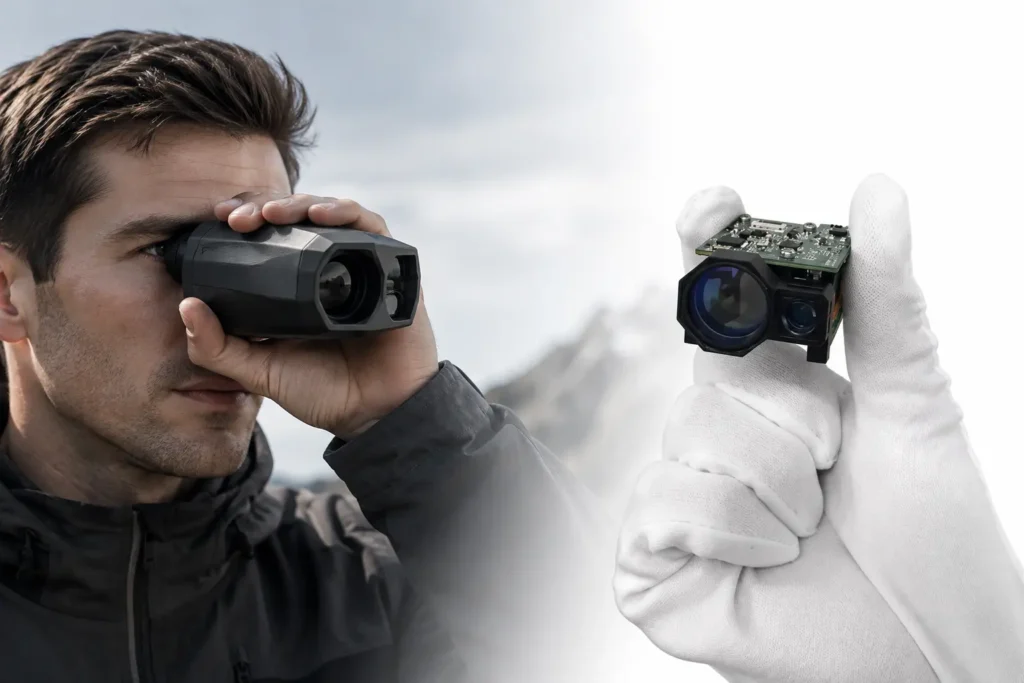
Class 1M and 2M exist because binoculars, riflescopes, and microscopes collect far more light than the human pupil. If your product could plausibly be viewed through optics — anything used outdoors, on a vehicle, or in a field-sighting role — the M classes are the ones to reason about.
Why 1535 nm changes the entire safety conversation
Wavelength is the highest-leverage safety decision available to a system designer, and it gets made too late in most programs.
Between roughly 400 nm and 1400 nm, the eye behaves like a well-corrected optical system. Light in this band passes through the cornea, lens, and vitreous and is focused onto the retina, concentrating energy by a factor of several thousand into a spot only micrometers across. This is the retinal hazard region. A modest amount of power at the cornea becomes a destructive irradiance at the retina, and retinal damage is permanent — there is no repair mechanism for photoreceptors.
Above about 1400 nm, the physics change. Water absorption in the cornea and aqueous humor rises sharply, and the radiation is absorbed in the front of the eye before it can reach the retina. Damage at these wavelengths, if it happens at all, occurs at the corneal surface, where tissue regenerates and where the MPE is orders of magnitude more permissive.
That is the whole basis of “eye-safe” laser design. It is not marketing language. It is a shift in where the energy lands.
For rangefinding and LiDAR, this produces a clear practical hierarchy:
905 nm sits deep in the retinal hazard region. It is inexpensive, works with silicon detectors, and can be engineered to Class 1 — but only by keeping pulse energy low, which caps range and hurts performance in rain, fog, and bright sun.
1064 nm is also retinal-hazard, and invisible, which is a poor combination for anything handheld or field-deployed. It remains common in pumped solid-state designs where the application justifies the controls.
1535 nm and 1570 nm clear the retinal hazard region entirely. The permissible exposure is dramatically higher, so a designer can push far more pulse energy downrange while remaining Class 1. That is why long-range rangefinders, UAV altimeters, and eye-safe LiDAR converge on erbium-glass and 1.5 µm fiber architectures. You buy range and atmospheric penetration with a safety margin you would not otherwise have.
The engineering cost is real: 1535 nm requires InGaAs detectors rather than silicon, which are more expensive and noisier. That trade — detector cost against range, safety class, and deployability — is the actual decision, and it is worth making explicitly rather than by default. Our team works through exactly this analysis with integrators specifying eye-safe ranging laser sources, because the wavelength choice cascades into detector selection, thermal budget, and the entire compliance path.
MPE, NOHD, and the numbers your customer’s safety officer will ask for
Three calculated values follow a laser product into every serious deployment. If you supply modules to defense, aerospace, or industrial integrators, expect to be asked for the data behind all three.
MPE (Maximum Permissible Exposure) is the exposure level below which injury is not expected, expressed as irradiance (W/cm²) or radiant exposure (J/cm²). It varies with wavelength, exposure duration, and pulse structure. ANSI Z136.1 tabulates it. For repetitively pulsed lasers the calculation is genuinely involved — single-pulse, average-power, and multiple-pulse criteria all have to be evaluated, and the most restrictive governs. This is where a lot of homegrown spreadsheets quietly get it wrong.
NOHD (Nominal Ocular Hazard Distance) is the distance along the beam beyond which irradiance drops below the MPE. Past the NOHD, unprotected viewing is acceptable. It is driven by output energy and beam divergence — which is why a tightly collimated low-power beam can carry a longer NOHD than a higher-power divergent one. For airborne and vehicle-mounted systems the NOHD often determines operational restrictions more than the class does.
NHZ (Nominal Hazard Zone) extends the idea into three dimensions, accounting for specular and diffuse reflections. A Laser Safety Officer defines the NHZ for a facility and sets the controls that apply inside it.
The control hierarchy that follows is standard occupational-safety logic, applied to photons. Engineering controls come first: enclosures, beam stops, interlocks, shutters, filtered viewports. These are preferred because they work without depending on human behavior, and they can reduce a Class 4 system to Class 1 at the operator’s position. Administrative controls come second: written procedures, alignment protocols, training, restricted access, warning signage. Personal protective equipment — eyewear of the correct optical density for the specific wavelength — comes last, because it protects only the person wearing it correctly at that moment.
One caution on eyewear. Optical density is wavelength-specific. Goggles rated for 1064 nm may offer close to zero protection at 1535 nm. Multi-wavelength labs need eyewear matched to every source present, and the LSO should verify OD against the actual worst-case exposure rather than the nameplate power.
What good suppliers do before a module reaches you
Safety classification is only trustworthy if the emission is stable — across units, across temperature, and across the product’s life. A module that meets Class 1 at 25 °C on day one, then drifts upward in pulse energy at −20 °C or after 2,000 hours, was never really a Class 1 product. It was a Class 1 measurement.
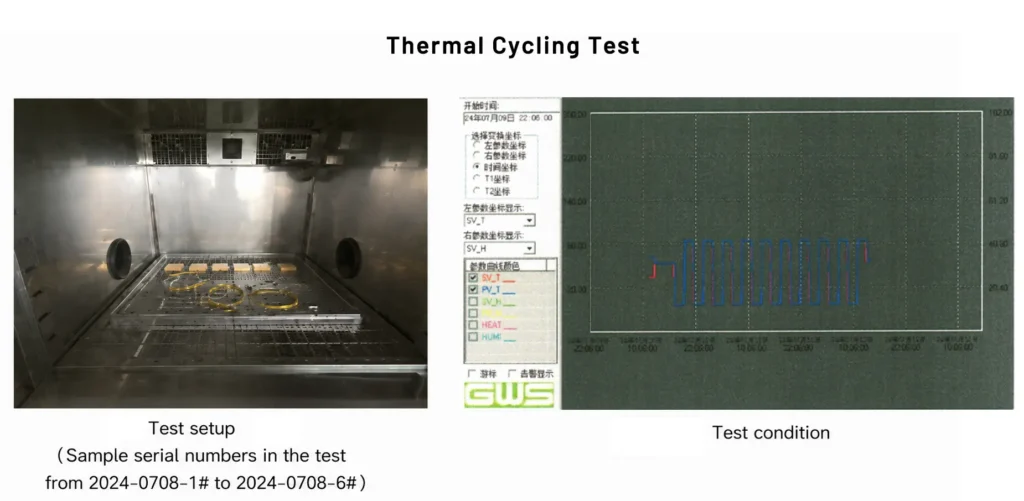
This is why manufacturing discipline is a safety issue and not just a quality issue. In our own flow, every unit moves through incoming inspection, chip test, die bonding and chip-on-submount assembly, fiber coupling and alignment, hermetic sealing by parallel seam welding, burn-in and aging screening, and final performance test. Burn-in exists specifically to find early-life failures before shipment. High/low temperature cycling validates the full operating window rather than one comfortable point on it. Hermetic sealing protects the emitter from the moisture ingress that shifts output over years in the field.
When you evaluate a laser source supplier, the questions worth asking are concrete. What is the unit-to-unit spread on pulse energy, and is it a specification or a typical value? What does emission look like at the temperature extremes, not just at ambient? Was every unit burn-in screened, or a sample? Can you see the test data for the serialized unit you received? Is there CE and RoHS conformity documentation, and can the supplier support your classification testing with real emission measurements?
A supplier who has helped customers through classification before will answer these directly. One who has not will send you a datasheet with typical values and hope you do not follow up. You can read more about how we approach laser design and qualification, and the same reasoning drives the source selection behind our LiDAR and 3D mapping work.
Common mistakes worth avoiding
Classifying the module instead of the system. Your finished product’s class depends on the enclosure, optics, and beam path around the module, not the bare emitter. Classify what the user can access.
Assuming eye-safe means safe. A 1535 nm source is far more forgiving of ocular exposure, but high peak power can still damage the cornea and skin, and it will still ignite materials at sufficient irradiance. “Eye-safe” describes a wavelength region, not immunity.
Testing only at nominal conditions. Classification measurement should cover the emission you can actually produce, including single-fault conditions. A drive circuit failure that doubles pulse energy is a foreseeable fault, and the standard expects you to have considered it.
Ignoring collecting optics. If your system will be used near binoculars, scopes, or cameras, evaluate the M-class conditions honestly.
Leaving classification to the end. Every item above is cheap to address during architecture and expensive to retrofit after tooling is committed.
Frequently asked questions
Is IEC 60825-1 or ANSI Z136.1 the one I need to comply with?
Both, usually for different reasons. IEC 60825-1 classifies and labels the product you manufacture and sell. ANSI Z136.1 governs how that laser is used safely in a US facility. Selling into the US also requires compliance with FDA 21 CFR Part 1040.
Can a high-power laser be Class 1?
Yes. Classification is based on accessible emission, not internal power. A multi-watt laser fully enclosed with interlocked access panels is commonly a Class 1 product, because no hazardous radiation reaches the user under normal operation or foreseeable fault.
Why is 1535 nm called eye-safe?
Wavelengths above about 1400 nm are absorbed by the cornea and aqueous humor before reaching the retina. Because the energy never focuses onto photoreceptors, the maximum permissible exposure is far higher than at 905 or 1064 nm, allowing more pulse energy within Class 1.
What is the difference between MPE and AEL?
MPE is the exposure limit for a person — how much radiation tissue can receive without expected injury. AEL is the emission limit for a product — how much radiation may be accessible from it. AELs are set so that a compliant product keeps users below the MPE.
Do I need a Laser Safety Officer?
ANSI Z136.1 requires an LSO wherever Class 3B or Class 4 lasers are used. For Class 1, 1M, 2, and 2M products the requirement generally does not apply, though a designated point of responsibility remains good practice.
Does laser class affect export or import requirements?
Class affects labeling, documentation, and market-access conformity such as CE marking and FDA reporting. Export licensing is a separate regime driven by performance and end use, not by safety class alone.
Getting the safety question settled early
The cheapest laser safety work happens in the first design review, when wavelength, pulse energy, divergence, and enclosure are all still negotiable. By the time you are measuring accessible emission on a production unit, your options are enclosures and labels.
If you are specifying a laser source and want the classification implications mapped out before you commit to an architecture, talk to our engineers — send your range, environment, and platform constraints, and we will work through the wavelength and safety trade-offs with you.
References
- International Electrotechnical Commission — IEC 60825-1:2014, Safety of laser products, Part 1: Equipment classification and requirements
- ANSI Blog — Laser Safety: Class 1, 1C, 1M, 2, 2M, 3R, 3B, and 4
- Occupational Safety and Health Administration — Laser Hazards: Standards
- Lasermet — ANSI Z136.1 vs. IEC 60825: Understanding Laser Classification Differences