
Laser pumping
Laser Pumping: Match the Gain Medium Before Pump Power
Lumexis develops fiber-coupled diode laser platforms for solid-state laser pumping, thulium and ytterbium fiber laser pumping, and OEM scientific instruments.
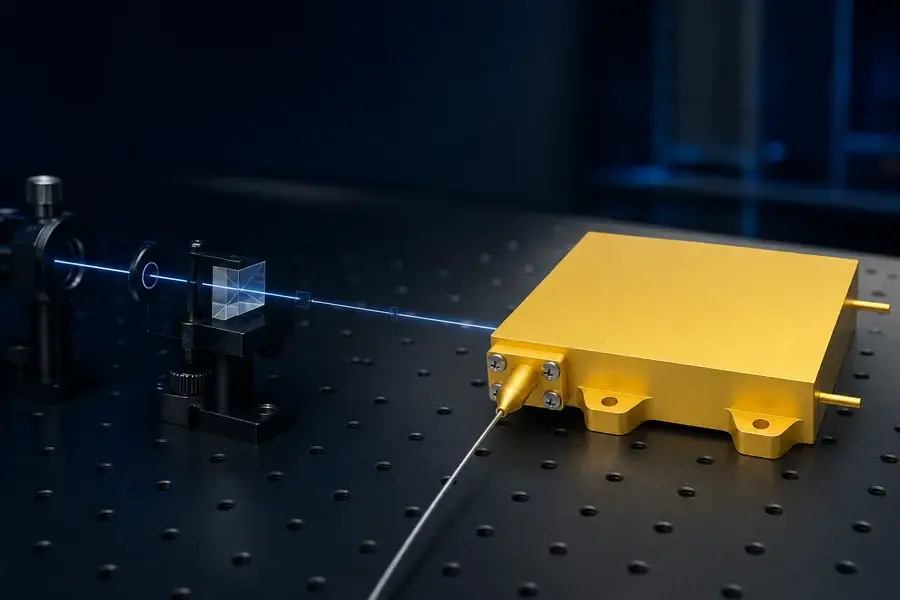
Match the gain medium before selecting pump power
A fiber-coupled pump laser transfers electrical power into the absorption band of a laser crystal or doped fiber. The correct source is therefore not simply the module with the highest wattage. Wavelength, spectral width, power in the useful absorption band, fiber core diameter, numerical aperture, back-reflection control and cooling must work together at the intended operating point.
Lumexis develops high-power fiber-coupled diode laser platforms for solid-state laser pumping, thulium fiber laser pumping, ytterbium fiber laser pumping and OEM scientific instruments. Current configurations include 792/793 nm, 808 nm, wavelength-stabilized 878.6/885/888 nm, and 915/976 nm families, with output interfaces and packaging selected around the host system.
Use this page as a first engineering match when the project needs:
- a 792/793 nm pump source for a thulium-doped fiber laser or amplifier;
- a practical 808 nm pump for a neodymium-doped solid-state laser;
- a narrow, wavelength-stabilized 878.6, 885 or 888 nm source for in-band neodymium pumping;
- a 915 or 976 nm source for an ytterbium-doped fiber laser or amplifier;
- fiber delivery that separates the pump module from the gain head;
- a defined combination of optical power, fiber core diameter and beam NA;
- an OEM configuration with agreed electrical, thermal, mechanical and monitoring interfaces.
Fast selection rule: Identify the gain material and its absorption spectrum first. Then choose the pump wavelength and locking requirement. Only after that should power, fiber core, NA, connector, drive current and cooling be sized as one operating point.
Quick application and wavelength match
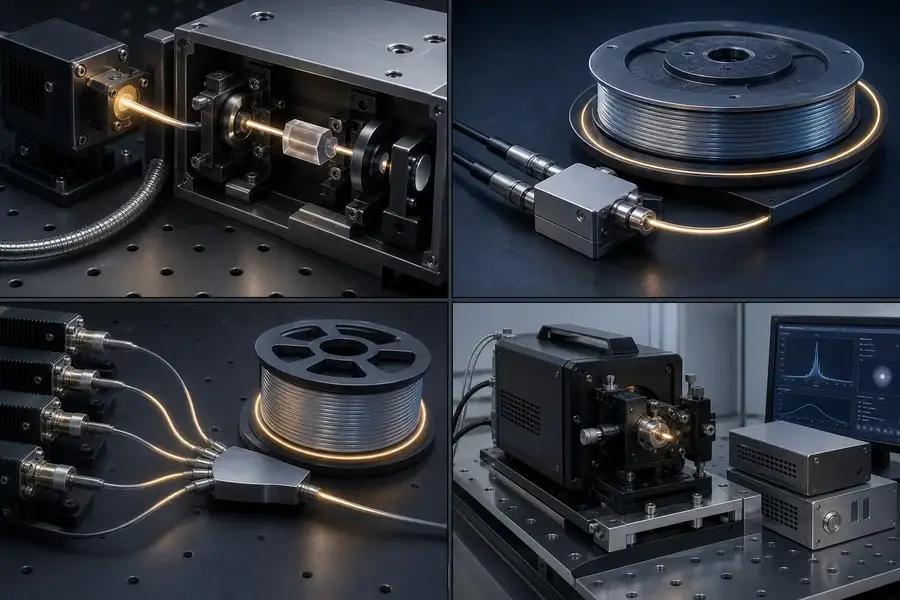
Application fit
Match the optical source to the real measurement task
Four industrial and scientific laser-pumping applications: solid-state crystal pumping, thulium fiber pumping, ytterbium fiber pumping and an OEM research instrument
| Host laser or gain medium | Lumexis starting wavelength | Why it is considered | First parameters to confirm |
|---|---|---|---|
| Nd:YAG, Nd:YVO4 and related neodymium solid-state systems | 808 nm | Widely used absorption band and a practical starting point for established DPSS architectures | Crystal and doping, absorption length, pump spot, CW or pulsed drive, required power |
| Neodymium systems designed for lower quantum defect | 878.6, 885 or 888 nm, wavelength-stabilized | Direct or in-band pumping can reduce the energy difference between pump and laser photons | Exact host absorption line, polarization, spectral tolerance, locking range and cooling |
| Thulium-doped fiber laser or amplifier | 792/793 nm | Common pump band for thulium systems using cross-relaxation in a suitable host | Active-fiber absorption, cladding geometry, fiber length, combiner acceptance and duty cycle |
| Ytterbium-doped fiber laser or amplifier | 915 nm | Broad pump band with lower absorption than the 976 nm peak; useful in architectures that value operating-band tolerance or wavelength multiplexing | Required active-fiber length, residual pump, combiner ports, thermal budget and target output |
| Ytterbium-doped fiber laser or amplifier | 976 nm | Strong absorption near the ytterbium zero-phonon line can support efficient absorption and compact active-fiber designs | Pump wavelength control, power in band, saturation behavior, active-fiber length and back reflection |
| OEM laser research and custom gain media | Application-specific | The gain material and resonator determine the useful wavelength, brightness and temporal format | Measured absorption data, pump geometry, operating mode, environment and qualification plan |
The table is a starting point, not a universal substitution guide. Absorption features vary with dopant, host composition, concentration, temperature and polarization. The final wavelength must be checked against the actual gain material used in the production system.
Where fiber-coupled pump lasers add system value
Diode-pumped solid-state lasers
Fiber delivery allows the pump source, electrical connections and heat-removal hardware to be packaged separately from the resonator. This can make the laser head smaller, simplify service access and give the optical designer more freedom to shape the pump spot at the crystal. The benefit depends on mode matching: pump light outside the useful gain volume adds heat without contributing effectively to the desired laser mode.
An 808 nm fiber-coupled laser is the practical baseline for many neodymium systems. Wavelength-stabilized 878.6, 885 and 888 nm options address designs that use a longer pump wavelength to reduce quantum defect and thermal loading. Those longer-wavelength designs require a gain medium and optical train developed for the selected absorption line; they are not drop-in replacements for every 808 nm cavity.
Thulium-doped fiber lasers
Around 792/793 nm, a pump photon can participate in a cross-relaxation process in appropriately doped thulium fiber, allowing one excited ion to transfer energy to a neighbouring ion. This can improve pump utilization, but the result depends on thulium concentration, glass composition, active-fiber geometry and operating conditions. Pump power must be matched to the cladding absorption and combiner, not selected from wavelength alone.
Ytterbium-doped fiber lasers and amplifiers
High-power ytterbium systems commonly launch pump light into the inner cladding of a double-clad active fiber. Pump combiners merge several delivery fibers while preserving enough brightness to enter the pump cladding. The active core generates the signal, while the larger inner cladding accepts the multimode pump.
At 976 nm, ytterbium absorption is strong but spectrally narrow. This can reduce the active-fiber length needed to absorb the pump, provided the source remains well aligned to the absorption band. Around 915 nm, absorption is weaker and broader. That may require more active fiber, but it can provide different tolerance and wavelength-combining options. The correct choice comes from a propagation, thermal and nonlinear-effect model of the complete fiber laser.
Scientific and OEM laser instruments
Research and industrial instruments often place additional limits on modulation, power stability, package size, electrical noise, service access and thermal drift. A custom fiber-coupled pump module should therefore be specified against the instrument operating sequence and its production test plan, not only a room-temperature optical-power target.
Lumexis pump-laser starting points
The following values consolidate locally documented Lumexis configurations for first-pass selection. Published product models are distinguished from wider engineering families. Final order values must be confirmed in the applicable drawing and order-specific specification.
| Pump family | Current starting points | Typical fiber interface in reviewed configurations | Primary solution fit |
|---|---|---|---|
| 792/793 nm | Engineering-configured family; representative 150 W configuration reviewed | 200 µm core, 0.22 fiber NA, SMA905 or pigtail options | Thulium-doped fiber pumping and custom solid-state systems |
| 808 nm | Published 25, 50, 150 and 400 W models | 105–400 µm core options; 0.22 fiber NA in reviewed models; SMA905 or pigtail options | Neodymium solid-state laser pumping |
| 878.6/885/888 nm locked | Engineering family from tens to hundreds of watts; published 885 nm models at 65, 120 and 270 W | Commonly 200 µm core and 0.22 fiber NA; SMA905 in reviewed models | Narrow-band in-band pumping of compatible neodymium gain media |
| 915 nm | Engineering-configured family extending from tens to hundreds of watts | 105–220 µm core in reviewed configurations; pigtail output common at higher power | Ytterbium fiber laser pumping |
| 976 nm | Published 120, 140, 260, 280 and 750 W models; additional engineering configurations available | 105–220 µm core in reviewed configurations; pigtail output common at higher power | Ytterbium fiber laser pumping where strong absorption is desired |
Representative published model match
| Model | Center wavelength | Output power | Fiber core | Fiber NA | Spectral note | Use as a starting point when… |
|---|---|---|---|---|---|---|
| 808-LXGX0025 | 808 nm | 25 W | 105 or 200 µm variant | 0.22 | Order-specific value to confirm | A lower-power solid-state pump architecture is being developed |
| 808-LXGX0050 | 808 nm | 50 W | 200 µm | 0.22 | Order-specific value to confirm | A defined 200 µm delivery interface suits the crystal pump optics |
| 808-LXGX0150 | 808 nm | 150 W | 135 or 200 µm variant | 0.22 | 5 nm in reviewed local specification | More pump power is required without moving to the 400 W class |
| 808-LXGX0400 | 808 nm | 400 W | 200 or 400 µm variant | 0.22 | Order-specific value to confirm | The design needs a higher-power 808 nm platform and can accept the associated fiber étendue |
| 885-LXGX0065 | 885 nm | 65 W | 200 µm | 0.22 | 1 nm in reviewed local specification | A locked long-wavelength neodymium pump is required at moderate power |
| 885-LXGX0120 | 885 nm | 120 W | 200 µm | 0.22 | 1 nm in reviewed local specification | The system needs a 120 W locked 885 nm starting point |
| 885-LXGX0270 | 885 nm | 270 W | 200 µm | 0.22 | 1 nm in reviewed local specification | Higher pump power must remain spectrally aligned to a narrow absorption band |
| 976-LXGX0120 | 976 nm | 120 W | 105 µm | Confirm for order | Order-specific value to confirm | The combiner benefits from a smaller-core 976 nm delivery fiber |
| 976-LXGX0140 | 976 nm | 140 W | 105 µm | 0.22 | 1 nm in reviewed local specification | A narrow 976 nm pump is required in the 140 W class |
| 976-LXGX0260 | 976 nm | 260 W | 135 µm | Confirm for order | Order-specific value to confirm | Power and fiber core need to be balanced for a medium-power combiner |
| 976-LXGX0750 | 976 nm | 750 W | 220 µm | 0.22 | Order-specific value to confirm | A high-power pigtail platform fits the host combiner and cooling design |
Do not interpolate unlisted combinations. A smaller fiber core at the same output power requires higher source brightness and places different stress on coupling optics and the fiber end. Connector choice also changes with power and return-light conditions.
How the pump module fits into the laser
System architecture
Review the complete optical and measurement chain
Conceptual fiber-coupled pump system architecture branching to a solid-state crystal laser and a double-clad fiber laser
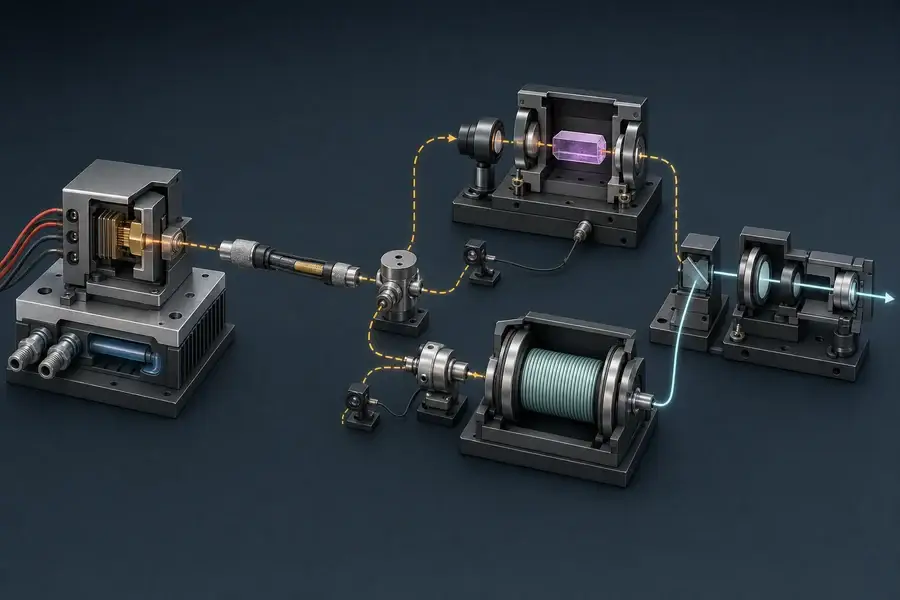
A typical pump chain contains more than the diode package:
- Constant-current driver: supplies controlled current and manages startup, shutdown and fault behaviour.
- Fiber-coupled diode module: combines emitter power into a defined delivery fiber.
- Thermal interface: removes the electrical power that is not converted into useful optical output.
- Delivery fiber and output interface: transports the multimode pump and defines the accepted core, NA, bend radius and termination.
- Pump optics or combiner: reshapes the pump into a crystal or combines several pumps into double-clad fiber.
- Gain medium: absorbs pump photons and creates population inversion.
- Resonator or amplifier path: converts stored excitation into the required signal wavelength and beam format.
- Monitoring and protection: may include thermistors, photodiodes, fiber-presence logic, interlocks and return-light management.
Every interface can consume margin. Coupling loss, connector contamination, overfilled NA, residual pump, absorption mismatch and elevated junction temperature can reduce useful efficiency even when the pump module meets its rated optical power.
Why spectral overlap matters
Spectral design
Match wavelength, filtering, and detector response
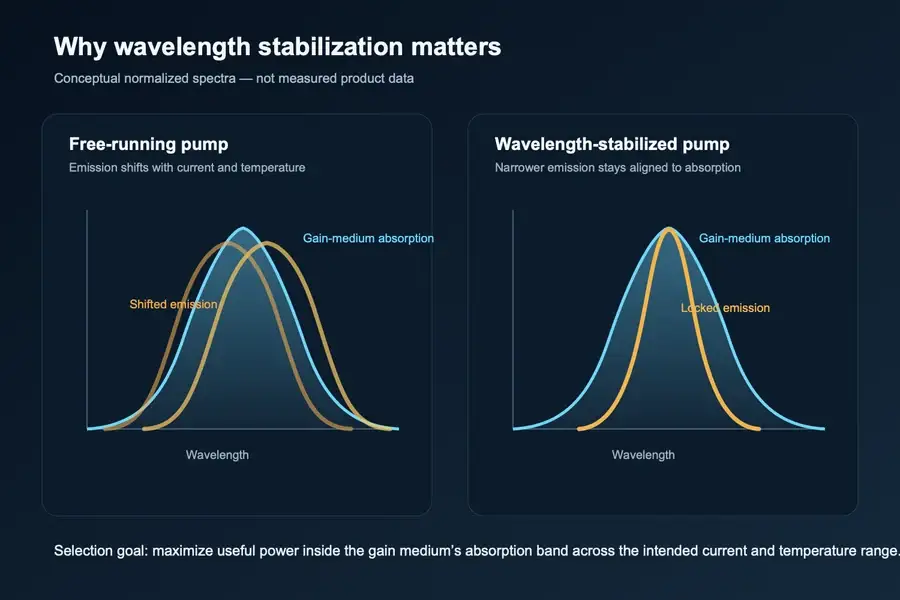
Conceptual comparison of a shifting free-running diode spectrum and a wavelength-stabilized pump aligned to a gain-medium absorption band
Semiconductor-laser wavelength changes with junction temperature and drive current. A broad or shifting spectrum may place part of the optical power outside a narrow absorption feature. The module can still produce its rated total watts while delivering less useful power to the gain medium.
For this reason, system engineers may specify:
- center wavelength and tolerance at a defined baseplate temperature;
- spectral width, normally with the measurement definition stated;
- wavelength drift with current and temperature;
- the fraction of power inside an agreed wavelength band;
- the current or power range over which wavelength lock is maintained;
- polarization behaviour when the gain medium is polarization-sensitive.
Volume Bragg grating stabilization forms a wavelength-selective external cavity for the diode emitters. It can narrow the spectrum and reduce wavelength movement so more pump power remains inside the useful absorption band. Lumexis reviewed configurations at 878.6, 885 and 888 nm specify locked operation over a defined fraction of rated power; the exact range must be confirmed for the selected model.
Wavelength locking does not remove the need for thermal control. It changes the sensitivity and usable operating window, but baseplate temperature, current distribution, optical alignment and the gain material still determine system performance.
Quantum defect explains part of the heat budget
For a pump wavelength (λ_p) and laser wavelength (λ_l), a useful first-pass fractional quantum defect is:
q = 1 − λp / λl
For a 1064 nm neodymium laser, the photon-energy difference is approximately 24.1% with 808 nm pumping and 16.8% with 885 nm pumping. The longer pump wavelength can therefore reduce one fundamental contribution to gain-medium heating.
These percentages are not complete wall-plug efficiencies and not guaranteed thermal reductions. Pump absorption, fluorescence, upconversion, non-radiative decay, resonator loss, unabsorbed pump, diode efficiency and cooling all remain in the system budget. A lower quantum defect can also come with a narrower or weaker absorption feature, increasing the importance of spectral control and pump geometry.
Power, fiber core and NA must be selected together
Optical delivery
Balance power, beam delivery, and target geometry
Engineering comparison showing how fiber core diameter and numerical aperture affect the usable brightness of a pump laser
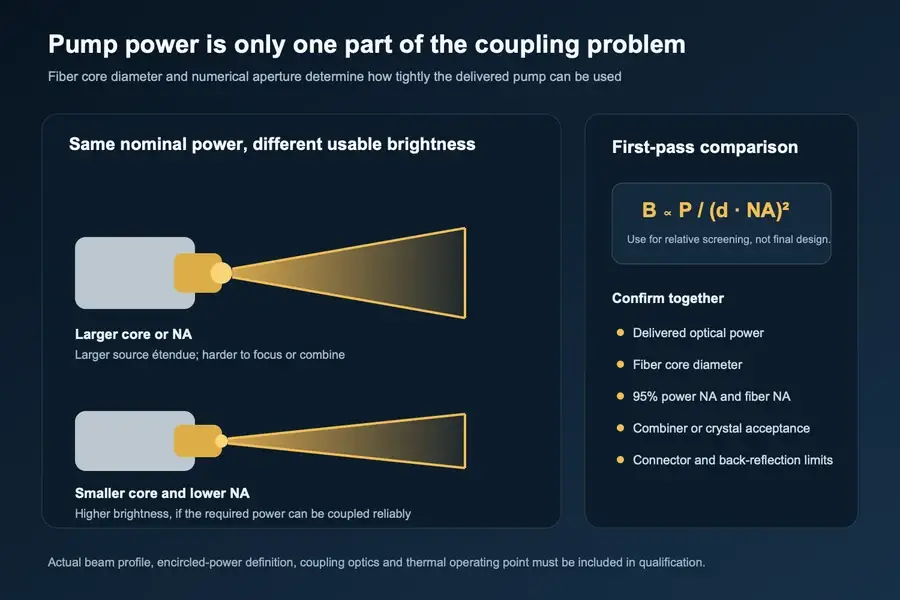
Optical power describes energy per unit time. It does not describe how tightly that power can be delivered. A first-pass comparison of multimode source brightness can use:
B ∝ P / (d·NA)2
where (P) is delivered power, (d) is fiber core diameter and (NA) is the beam numerical aperture under a consistent power-content definition.
The relationship explains why 200 W in a smaller core and lower NA is not equivalent to 200 W in a larger core or wider angular distribution. Higher brightness can support tighter focusing into a crystal or better coupling into a pump combiner. It is also more difficult to achieve reliably and may change fiber-end intensity, connector choice and contamination sensitivity.
When comparing modules, ask whether the stated NA is:
- the fiber’s nominal acceptance NA;
- the measured beam NA containing 90%, 95% or another fraction of power;
- measured at the fiber output under rated current;
- stable across power, temperature and production units.
For solid-state end pumping, propagate the measured near-field and far-field distribution through the coupling optics and compare the pump volume with the resonator mode. For fiber-laser pumping, compare delivery-fiber core and NA with every combiner input and the active fiber’s pump cladding.
Electrical efficiency becomes a thermal design input
Electro-optical efficiency is:
ηeo = Poptical / (VI)
The approximate heat that must be removed from the pump module is then:
Pheat ≈ VI − Poptical
This simple expression does not replace a detailed thermal model, but it prevents a common integration error. A 750 W optical source at 48% electro-optical efficiency would require roughly 1.56 kW of electrical input and reject roughly 0.81 kW as heat at that operating point. The calculation is illustrative; final voltage, current and efficiency must come from the approved specification and test condition.
Size the baseplate, coolant loop, power supply, conductors and protection around the worst qualified operating condition—not a typical room-temperature value. Record coolant inlet temperature, flow, pressure drop, baseplate flatness, interface material and fastener preload so the laboratory result can be reproduced in production.
Back reflection and the fiber interface
Pump light reflected from a combiner, crystal face, connector or damaged fiber end can return to the diode emitters. Depending on wavelength and architecture, it can disturb the spectrum, create local heating or damage optical surfaces.
Define these items before design release:
- fixed pigtail, bare fiber or detachable connector;
- fiber core, cladding, coating, jacket and length;
- output-end geometry and cleaning method;
- minimum bend radius and strain relief;
- permitted return wavelength and maximum return level;
- whether isolation or a protective termination is integrated;
- connector temperature monitoring for higher-power systems;
- handling procedure with the driver disabled and the fiber protected.
An SMA905 interface can be practical at some power levels, while higher-power architectures often use a fixed pigtail into a pump combiner. The choice must follow the delivered intensity, service model and back-reflection risk of the complete laser.
Integration checklist for OEM engineering teams
Optical
- Confirm gain material, dopant concentration, host and measured absorption spectrum.
- Define pump wavelength, tolerance, spectral width and required power in band.
- Specify CW, quasi-CW or modulated operation and the complete duty cycle.
- Match delivery-fiber core and beam NA to the pump optics or combiner.
- Calculate absorbed rather than merely launched pump power.
- Define return-light conditions and residual-pump handling.
Electrical and control
- Use a low-ripple constant-current driver with controlled rise and fall behaviour.
- Define maximum current, compliance voltage, startup sequence and fault response.
- Confirm whether the module contains a thermistor, monitor photodiode or other sensors.
- Prevent current overshoot during enable, modulation and fault recovery.
- Coordinate pump shutdown with coolant, fiber and host interlocks.
Thermal
- Specify the allowed baseplate or coolant temperature, not only room ambient.
- Model heat from the pump module, driver, combiner and gain medium separately.
- Validate temperature distribution at the longest sustained operating sequence.
- Monitor for reduced flow, blocked channels and connector heating.
- Include fouling, coolant quality and service interval in the life-cycle design.
Mechanical and fiber routing
- Use the controlled mounting surface and approved fastener pattern.
- Protect the fiber exit from side load, shock and enclosure tolerances.
- Maintain bend radius through assembly, transport and service positions.
- Provide access for inspection and cleaning without moving the resonator datum.
- Freeze the pigtail length and connector orientation before production validation.
Qualification should reproduce the final laser operating point
| Test | What to record | Design question answered |
|---|---|---|
| Light-current-voltage test | optical power, voltage, current and efficiency | Is the electrical and thermal budget correct? |
| Spectrum versus current and temperature | center wavelength, width and power in band | Does the pump remain aligned to absorption? |
| Near-field and far-field test | beam profile, encircled-power NA and stability | Will the pump enter the optics or combiner efficiently? |
| Long-duration operation | output drift, temperatures, flow and power draw | Can the host sustain the real duty cycle? |
| Modulation test | optical rise/fall, overshoot and wavelength behaviour | Does dynamic operation stay inside limits? |
| Return-light test | stability, fault response and post-test output | Is the optical interface adequately protected? |
| Fiber handling test | connector temperature, bend loss and strain response | Is the routing and service procedure robust? |
| Gain-medium test | absorbed pump, output power, slope behaviour and thermal lens | Does module performance translate into laser performance? |
| Unit-to-unit comparison | optical, spectral, electrical and beam statistics | Are production limits suitable for the system margin? |
Pump-module qualification and host-laser qualification answer different questions. The module test proves the source under defined conditions. The host test proves absorption, coupling, laser output, thermal stability and protection as one system.
What to include in a fiber-coupled pump laser RFQ
| Category | Information to provide |
|---|---|
| Gain medium | material, dopant, concentration, host and absorption data |
| Host architecture | solid-state crystal, fiber oscillator, fiber amplifier or research instrument |
| Pump wavelength | target, allowable tolerance, spectral width and locking requirement |
| Optical power | required launched and absorbed power, operating range and stability |
| Operating mode | CW, pulse or modulation waveform, rate, duty cycle and rise/fall requirements |
| Fiber interface | core, cladding, NA, length, jacket, connector or pigtail termination |
| Pump receiver | crystal optics or combiner input core, NA, loss and permitted return power |
| Electrical | available current, voltage, driver topology, monitor and interlock requirements |
| Thermal | coolant or baseplate temperature, flow, pressure drop and available heat rejection |
| Mechanical | envelope, mounting datum, fiber-exit direction, mass and service access |
| Environment | operating temperature, vibration, humidity, contamination and storage conditions |
| Production | prototype quantity, annual volume, traceability and acceptance-test requirements |
If the laser design is still early, send the gain material, target output wavelength and power, preferred pump geometry and available cooling first. Those inputs expose the most important wavelength, brightness and thermal decisions.
Frequently asked questions
What is a fiber-coupled pump laser?
It is a semiconductor laser module that combines diode-emitter output into an optical fiber for delivery to a laser gain medium. The fiber simplifies routing and separates the pump source from the crystal or active fiber, but its core and NA become part of the optical design.
Is 808 nm or 885 nm better for Nd:YAG pumping?
Neither is universally better. 808 nm is the established pump band and is often easier to absorb. A compatible 885 nm in-band design can reduce quantum defect and gain-medium heat, but usually places tighter demands on spectral alignment, crystal design and resonator optimization.
Why use 792/793 nm to pump thulium fiber?
This band can drive a cross-relaxation process in appropriately doped thulium fiber, supporting efficient population of the upper laser level. Actual efficiency depends on glass composition, dopant concentration, geometry, loss and thermal conditions.
Should an ytterbium fiber laser use 915 nm or 976 nm pumps?
976 nm offers strong absorption near a narrow peak and can support shorter active-fiber designs. 915 nm provides a broader, weaker absorption band and may suit architectures using longer fiber or wavelength multiplexing. Model both choices with the actual active fiber and target output.
Does higher pump power always produce more laser output?
No. Output also depends on absorbed pump, overlap with the laser mode, gain saturation, resonator loss, nonlinear limits and heat removal. More launched power can become residual pump or heat if the rest of the system cannot use it.
Why does fiber core diameter matter if two modules have the same watts?
A smaller core generally provides higher spatial brightness for the same power and NA. This can improve focusing or combiner coupling, but it increases coupling difficulty and fiber-end intensity. Core diameter, beam NA and power must be compared together.
What does wavelength locking change?
It narrows and stabilizes diode emission so a larger share of pump power can remain inside a narrow gain-medium absorption band as current and temperature change. The required locked range and power-in-band definition should be stated in the specification.
Can the maximum power be used at every temperature and duty cycle?
Do not assume so. Rated output is tied to current, voltage, cooling, baseplate temperature, fiber condition and operating mode. Confirm the exact operating map required by the host laser.
What information is most important for customization?
Begin with the gain medium and absorption band, required pump power, fiber core and NA, operating mode, cooling conditions, return-light environment and mechanical envelope. These determine whether a standard model or an engineering configuration is the better starting point.
Build the pump around absorbed power, not catalogue watts
Reliable laser pumping starts with the gain medium and ends with an operating point that the driver, fiber, optics, combiner and cooling system can reproduce. Selecting those interfaces together reduces redesign, protects useful efficiency and gives production teams a clearer acceptance test.
Lumexis works with OEM laser builders to configure fiber-coupled pump lasers across 792/793 nm, 808 nm, wavelength-stabilized 878.6/885/888 nm and 915/976 nm families for civil, industrial and scientific laser systems.
Discuss your laser-pumping requirements with our engineering team.
Please include the gain medium, target laser output, required pump wavelength and power, fiber core and NA, operating mode, cooling conditions and expected production volume.
Lumexis — precision laser sources, engineered for the real world.
Technical references
- Coherent: FACTOR Series fiber-coupled diode laser module — representative matching of 808/88x, 793 and 9xx nm pump bands to neodymium-, thulium- and ytterbium-doped materials.
- RP Photonics: Neodymium-doped laser gain media — 808 nm pumping and longer-wavelength direct pumping of neodymium gain media.
- RP Photonics: Quantum defect — definition and the 808 nm to 1064 nm Nd:YAG example.
- nLIGHT: Wavelength-stabilized fiber-coupled modules for DPSS and fiber-laser pumping — spectral overlap, power in band and volume Bragg grating stabilization.
- Optica: Wavelength stabilization and spectrum narrowing by volume Bragg gratings — peer-reviewed demonstration of spectral narrowing and stabilization for high-power diode sources.
- Coherent: Improved DPSS laser performance with 880 nm pump diodes — 878.6, 885 and 888 nm wavelength-stabilized pumping and system-efficiency context.
- Lumentum: Optical pumping — system-level role of fiber-coupled diode sources in solid-state and fiber-laser pumping.
- Coherent: New FACTOR Series diode pumps — current 793 nm thulium pump and locked 878.6/885/888 nm industry context.
- Coherent: Matched thulium-doped double-clad optical fiber — 793 nm pumping, thulium cross-relaxation and active-fiber design context.